

Beating the Buzzer on Your Beneficial Ownership Report Extension
Why Tracking Your Beneficial Owner Information Deadline Matters Now More Than Ever
Beneficial owner information deadline tracking has become increasingly complex following FinCEN's March 2025 interim final rule that fundamentally reshaped who must file and when. If you're a foreign entity registered to do business in the United States, understanding these new timelines is critical to avoiding penalties.
Current BOI Filing Deadlines (2025):
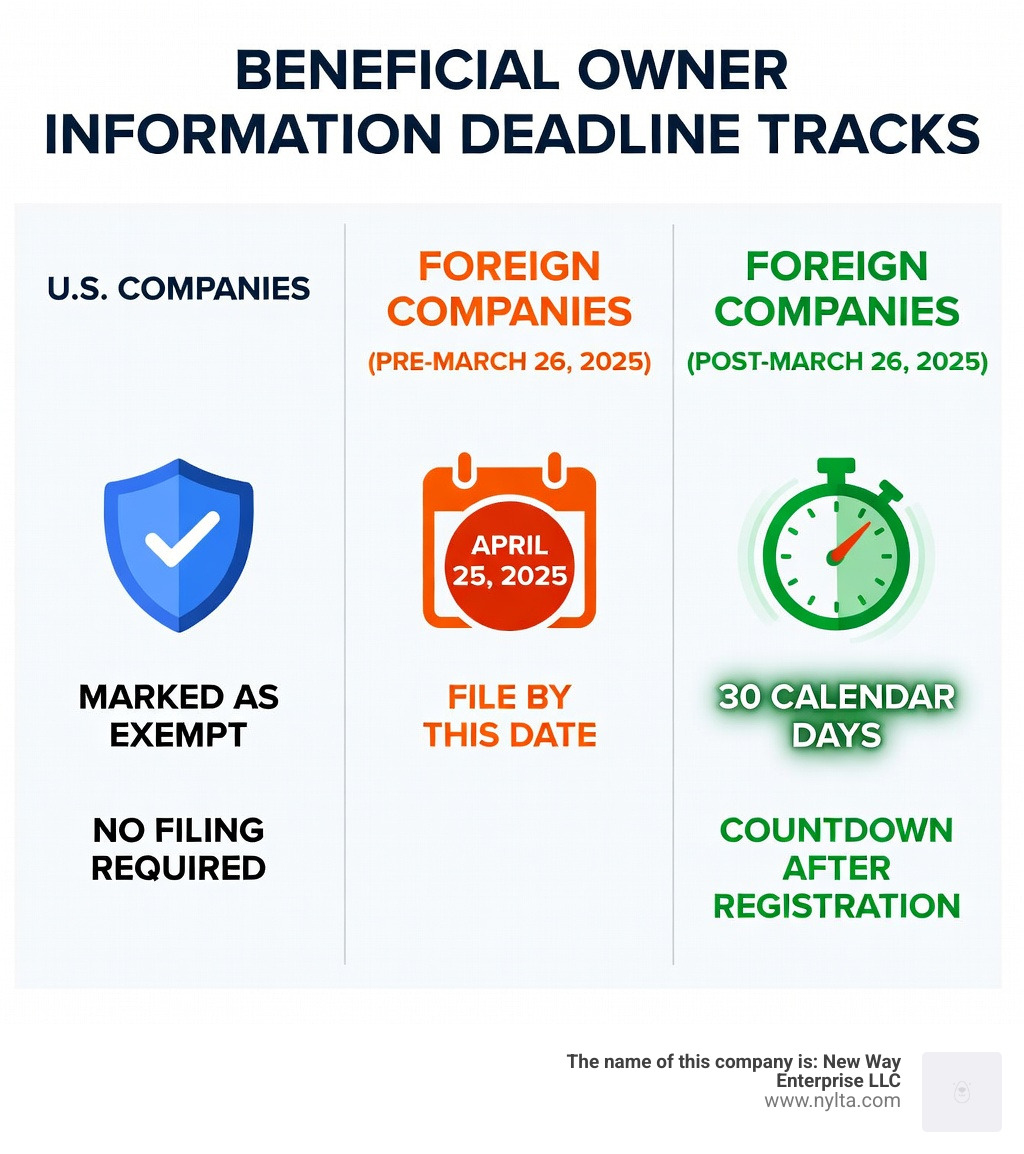
Entity Type Registration Date Filing Deadline Foreign reporting companies Before March 26, 2025 April 25, 2025 Foreign reporting companies On or after March 26, 2025 30 calendar days after registration notice U.S. domestic companies Any date Fully exempt (no filing required) Disaster-affected entities Varies Original deadline plus 90 days
The regulatory landscape shifted dramatically on March 21, 2025, when FinCEN announced the removal of BOI reporting requirements for all U.S.-created entities. This means only foreign entities registered to do business in U.S. states or tribal jurisdictions must now file beneficial ownership information reports.
For foreign LLCs authorized in New York, this creates a dual compliance challenge: tracking the federal BOI deadline while also monitoring New York's LLC Transparency Act requirements, which remain separate and enforceable with penalties reaching $592 per day.
The stakes are high. Missing your deadline can trigger both civil and criminal penalties under the Corporate Transparency Act, while New York's state-level requirements add another layer of risk. The good news? The filing deadlines are now clearer for foreign entities than they've been since the CTA took effect in January 2024.
Understanding the New Beneficial Owner Information Deadline Landscape

If you feel like the rules for the Corporate Transparency Act (CTA) have been changing faster than a New York minute, you aren't alone. On March 21, 2025, the Financial Crimes Enforcement Network (FinCEN) issued a major announcement that turned the compliance world on its head. This move was formalised through an Interim Final Rule published on March 26, 2025, which effectively narrowed the scope of federal BOI reporting.
Before this update, millions of small U.S. businesses were scrambling to meet various deadlines. Now, the burden has shifted exclusively to "foreign reporting companies." According to the new rule, any entity created under the laws of a foreign country that registers to do business in the United States by filing a document with a Secretary of State (or similar office) is the only type of "reporting company" left standing in the eyes of federal law.
FinCEN made this change to reduce the regulatory burden on domestic small businesses, estimating that the interim final rule will save U.S. companies approximately $13.6 billion in first-year compliance costs. On a going-forward basis, the annual savings are estimated at roughly $9 billion.
Deadline Category Original Requirement (Pre-2025) Revised Requirement (March 26, 2025) Domestic LLCs/Corps Required to file (Jan 1, 2025) Exempt U.S. Persons Must be reported as BOs Exempt Foreign Entities 1 year for existing; 90 days new April 25, 2025 (existing); 30 days (new)
Filing Timelines for Foreign Reporting Companies
For those of us managing foreign entities, the clock is officially ticking. While domestic companies are breathing a sigh of relief, foreign entities must ensure they check out the BOI webpage frequently to stay abreast of any further tweaks.
The definition of a foreign reporting company is specific: it’s an entity formed under the law of a foreign country that has registered to do business in any U.S. State or Tribal jurisdiction. If your entity falls into this category, your beneficial owner information deadline depends entirely on when that U.S. registration became effective.
Beneficial Owner Information Deadline for New Foreign Registrants
If you are just now bringing your foreign business into the U.S. market, pay close attention. For any foreign reporting company registered on or after March 26, 2025, you have exactly 30 calendar days to file your initial report. This countdown begins the moment you receive actual or public notice that your registration is effective.
To fulfill this requirement, you must use the official form to report BOI. Unlike some state filings, there is no fee involved with filing this report directly through FinCEN’s E-Filing system.
Deadlines for Pre-Existing Foreign Entities
What if your foreign company was already registered to do business in the U.S. before the rules changed on March 26, 2025? FinCEN has set a firm "catch-up" date. You must file your BOI report no later than April 25, 2025.
This deadline is a significant acceleration for many who thought they had until the end of the year. The authority for these requirements stems from 31 U.S.C. 5336(b), and FinCEN expects roughly 11,667 foreign reporting companies to file each year moving forward.
Navigating Exemptions and Special Extensions
One of the most surprising parts of the March 2025 update is the blanket exemption for domestic reporting companies under 31 CFR 1010.380(c). By redefining "reporting company" to exclude those created within the U.S., FinCEN has effectively removed millions of entities from the system.
Furthermore, there is a specific exemption regarding the individuals who must be reported. Foreign reporting companies no longer need to report the BOI of any U.S. persons who are beneficial owners. The focus is now strictly on identifying non-U.S. individuals who exercise substantial control or own at least 25% of the foreign entity.
Disaster Relief and the Beneficial Owner Information Deadline
Mother Nature doesn't always consult the federal calendar. Recognizing this, FinCEN provides relief for businesses located in FEMA-designated disaster areas. If your principal place of business is in an area affected by major events—such as Hurricane Helene or Hurricane Milton—you may be eligible for an extension.
Generally, this relief grants an additional 90 days from the original deadline. To see if your area qualifies, FinCEN posts specific disaster relief notices on its website. This extension often aligns with IRS tax relief windows, giving business owners much-needed breathing room to recover before focusing on paperwork.
Impact of Litigation on Your Beneficial Owner Information Deadline
The path to these 2025 rules was paved with lawsuits. Cases like National Small Business United v. Yellen and the Smith court order created a "yo-yo" effect for compliance. At one point, a district court in Texas issued a nationwide preliminary injunction, temporarily stopping FinCEN from enforcing the CTA.
However, the Treasury Department fought back, and the Smith order eventually reactivated the requirements while appeals were pending in the Fifth Circuit. It was this legal volatility—and the unanimous passage of the "Protect Small Businesses from Excessive Paperwork Act of 2025" in the House—that ultimately pushed FinCEN to issue the March interim final rule. The agency used its authority under 31 U.S.C. 5336(a)(11)(B)(xxiv) to exempt domestic companies and simplify the whole mess.
Avoiding Scams and Filing Correctly
Whenever there is a major government deadline, scammers come out of the woodwork. We have seen reports of fraudulent correspondence referencing a fake "Form 4022" or claiming to be from the "US Business Regulations Dept."
Here are the golden rules for staying safe:
No Filing Fee: FinCEN does not charge a fee to file your BOI report. If a website asks for payment to "register" you with the federal government, it is likely a scam.
Watch the Links: Do not click on suspicious URLs or QR codes in emails. Always navigate directly to the official government portals.
The FinCEN Identifier: If you are an individual who owns multiple entities, you can apply for a FinCEN identifier. This unique number can be used on future reports in place of your personal details, keeping your data more secure.
If you encounter something fishy, you can report it or ask questions via www.fincen.gov/contact.
Frequently Asked Questions about BOI Deadlines
Do U.S. companies still need to file BOI reports?
No. As of the March 26, 2025, interim final rule, all domestic reporting companies—those created by filing a document with a U.S. Secretary of State—are fully exempt from federal BOI reporting requirements. This is codified in the revised 31 CFR 1010.380(c)(1)(i).
Must foreign companies report U.S. beneficial owners?
No. Under the updated rules and 31 U.S.C. 5318(a)(7), foreign reporting companies are exempt from reporting the BOI of any U.S. persons. You only need to report beneficial owners who are non-U.S. persons. This significantly reduces the amount of sensitive data foreign companies must collect from their American partners or investors.
What are the penalties for missing the foreign entity deadline?
Even though the rules have narrowed, the teeth of the law remain sharp for foreign entities. Failure to report complete or updated beneficial ownership information can result in civil penalties of up to $500 for each day the violation continues (adjusted for inflation, this can be higher). Criminal penalties, including fines of up to $10,000 and imprisonment for up to two years, are also possible for willful violations. You can find the full penalty structure under 31 CFR 1010.380.
Conclusion
Staying compliant in this shifting landscape requires constant vigilance. At New Way Enterprise LLC, we know that while federal rules have relaxed for many, state-level requirements are a different story entirely.
If you operate an LLC in New York, you aren't off the hook just because FinCEN changed its mind. The New York LLC Transparency Act (NYLTA) is very much in effect. This state law requires LLCs to disclose their beneficial owners to the New York Department of State, and unlike the federal CTA, it still applies to domestic New York entities.
To make sure you don't miss a beat, More info about NYLTA services is available to help you navigate automated status assessments and secure filings. Whether you are beating the federal beneficial owner information deadline or ensuring your New York disclosures are accurate, we are here to help you navigate the red tape with ease.