The No-Nonsense Guide to Beneficial Ownership Filing
Understanding the New Landscape of Beneficial Ownership Filing
Beneficial ownership filing has undergone a dramatic change in 2025, leaving many business owners confused about who must report and when. Here's what you need to know right now:
Key Updates for 2025:
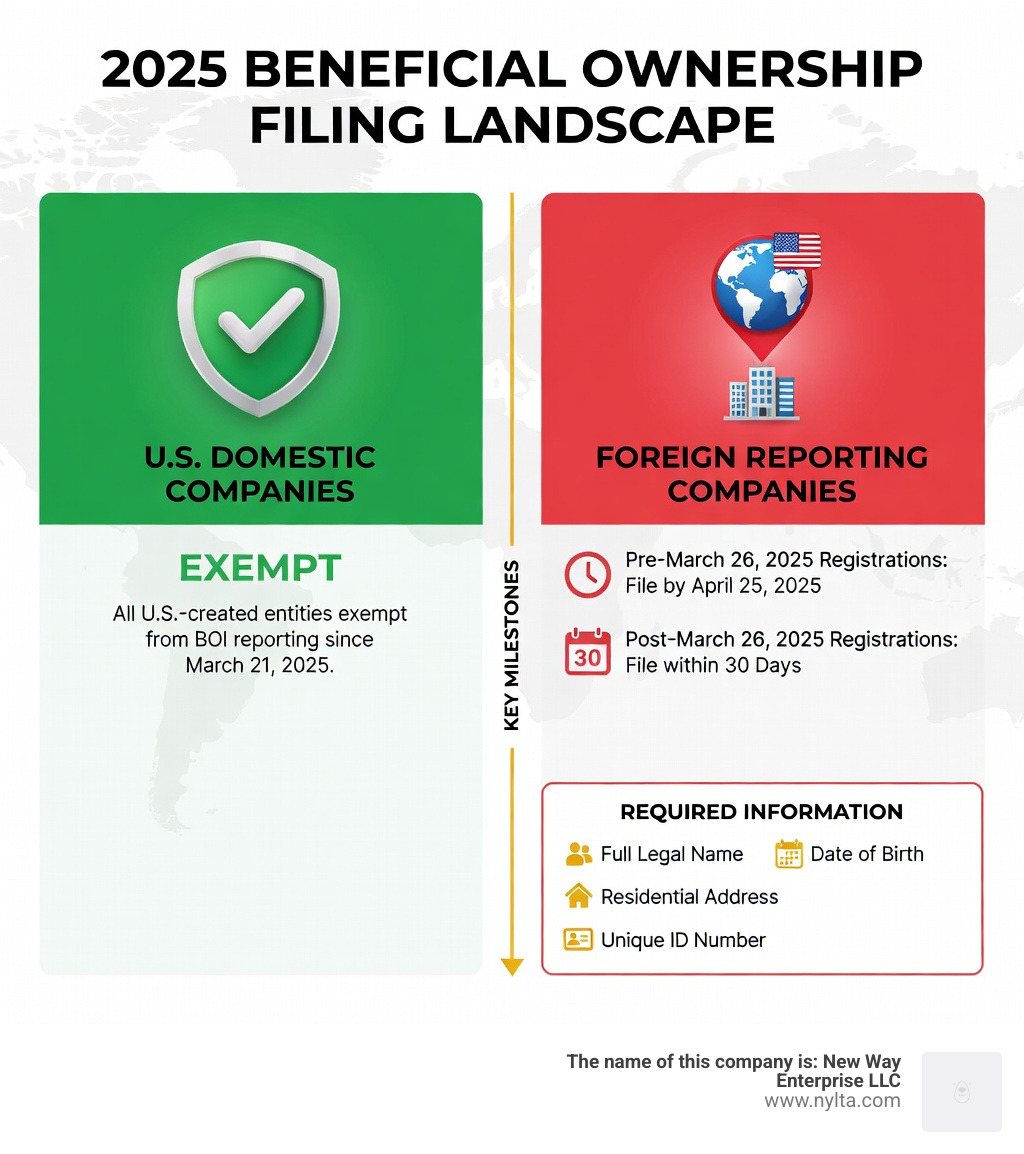
U.S. domestic companies are now exempt - As of March 21, 2025, all entities created in the United States no longer need to file beneficial ownership information (BOI) with FinCEN
Foreign companies registered in the U.S. must still file - If your LLC or corporation was formed outside the U.S. but registered to do business in any U.S. state, you have strict deadlines
April 25, 2025 is the critical deadline - Foreign reporting companies registered before March 26, 2025 must file by this date
30-day window for new registrations - Foreign entities registering after March 26, 2025 have 30 calendar days from their effective registration date
No fees to file - FinCEN's BOI portal is completely free; any payment requests are scams
The Corporate Transparency Act (CTA) was enacted in 2021 to combat money laundering, terrorism financing, and other illicit activities by requiring transparency in business ownership. For years, criminals exploited shell companies with hidden owners to move illegal funds. The CTA aimed to close that loophole.
But the rules have changed significantly. After FinCEN's interim final rule published on March 26, 2025, the definition of "reporting company" was revised to exclude all U.S.-created entities and U.S. persons entirely. Only foreign entities registered to conduct business in the United States now face federal BOI reporting requirements.
If you're a foreign LLC owner authorized to operate in New York or other states, you're navigating a complex compliance landscape with serious penalties for missing deadlines. Getting this wrong can mean daily fines, legal trouble, and operational disruptions.
This guide cuts through the confusion to explain exactly what beneficial ownership filing means today, who must comply, what information you need to submit, and how to avoid costly mistakes and scams.
The 2025 FinCEN Rule: New Standards for Beneficial ownership filing
The landscape of Beneficial ownership filing shifted beneath our feet in early 2025. For a long time, the Corporate Transparency Act (CTA) was the "big bad wolf" for every small business owner in the United States. However, a massive regulatory pivot has changed the game.
The Domestic Exemption
In a move that surprised many, the announcement on March 21, 2025, by the Financial Crimes Enforcement Network (FinCEN) effectively hit the "delete" button for U.S. domestic reporting requirements. Consistent with a Department of the Treasury announcement earlier that month, FinCEN issued an interim final rule that removes the requirement for U.S. companies and U.S. persons to report beneficial ownership information.
This means if you formed your LLC in Delaware, New York, or Florida, you are no longer a "reporting company" under the federal CTA. You and your beneficial owners are exempt from filing with FinCEN.
Foreign Reporting Companies
The burden hasn't vanished for everyone. The rule specifically targets foreign reporting companies. These are entities (like corporations or LLCs) formed under the law of a foreign country that have registered to do business in any U.S. state or with a Tribal office.
If your company was born in Canada, the UK, or anywhere else outside the U.S., but you’ve filed paperwork to operate legally within the States, you are still on the hook for a Beneficial ownership filing.
Revised Reporting Company Definition
Under the new FinCEN rule, the definition of a "reporting company" has been narrowed. It now excludes all domestic entities and focuses solely on foreign entities registered in the U.S. Furthermore, U.S. persons—even those who might own or control a foreign reporting company—are no longer required to be reported as beneficial owners to FinCEN.
Entity Type Reporting Required? Deadline (if applicable) U.S. Domestic LLC/Corp No (Exempt) N/A U.S. Citizen/Resident No (Exempt) N/A Foreign Entity (Pre-March 26, 2025) Yes April 25, 2025 Foreign Entity (Post-March 26, 2025) Yes 30 Days from Registration
Information Required for a Beneficial ownership filing
If you fall into the category of a foreign reporting company, you must provide specific details about the individuals who own or control the company. According to the FinCEN BOI E-Filing instructions, you’ll need to collect the following for each beneficial owner:
Full Legal Name: No nicknames or "known as" aliases.
Date of Birth: To verify the individual's identity.
Residential Address: This must be a physical home address, not a P.O. Box or a business address.
Unique ID Number: You must provide a number from a non-expired U.S. driver’s license, a state/local/tribal ID, or a U.S. passport. If the individual has none of these, a foreign passport is acceptable.
Image of the ID: A clear photo or scan of the identification document used (maximum 4MB).
Filing Deadlines for Foreign Reporting Companies
Timing is everything. If you are a foreign reporting company, your calendar should have these dates circled in red:
Existing Registrations: If your foreign company was registered to do business in the U.S. before March 26, 2025, your Beneficial ownership filing is due by April 25, 2025.
New Registrations: If you register on or after March 26, 2025, you have 30 calendar days to file after receiving notice that your registration is effective.
Updates and Corrections: If any information in your report changes (like a beneficial owner moving to a new house) or if you find an error, you have 30 days to file an updated or corrected report.
Beneficial Ownership in Canada: CBCA and Ontario Rules
While the U.S. has eased its federal requirements for domestic companies, Canada is moving in the opposite direction, amping up transparency through the "Individual with Significant Control" (ISC) framework.
The 25% Threshold
In Canada, a beneficial owner is known as an Individual with Significant Control (ISC). This is generally defined as someone who:
Owns, controls, or directs 25% or more of the voting shares.
Owns shares worth 25% or more of the fair market value of all outstanding shares.
Has "significant influence" over the corporation without necessarily hitting the 25% ownership mark.
Federal Requirements (CBCA)
As of January 22, 2024, all federal business corporations under the Canada Business Corporations Act (CBCA) must file their ISC information with Corporations Canada. Minister Champagne on federal filing noted that this database helps establish a "database of beneficial ownership information" to strengthen safety and economic interests.
Corporations must file this info:
On the day of incorporation.
Within 30 days of an amalgamation or filing an annual return.
Within 15 days of any change to the ISC information.
Maintaining Records for a Beneficial ownership filing in Ontario
Ontario has its own set of rules for privately-held corporations. Since January 1, 2023, these companies have been required to keep an internal register of beneficial ownership.
According to Ontario's ISC record-keeping guide, you don't necessarily "file" this with a public registry like the federal companies do. Instead, you must maintain this information at your registered office.
Key Ontario Rules:
Update Frequency: You must update the information at least once a year and within 15 days of becoming aware of any changes.
Access: While not public, you must provide this information to law enforcement, tax authorities, or regulatory bodies upon request.
Exemptions: Public corporations and their wholly-owned subsidiaries are generally exempt from these record-keeping requirements.
Comparing Federal and Provincial Requirements
The Canadian landscape is a patchwork of rules. While the federal CBCA requires a public-facing (though limited) database, Ontario focuses on internal registers. Quebec is already collecting data, and British Columbia is expected to start its own beneficial ownership collection in 2025.
One unique aspect of the Canadian definitions is how they handle "related persons." In Ontario, if a group of related persons (like a spouse or children living in the same house) collectively controls 25% of the shares, they are all considered individuals with significant control.
Compliance Risks: Penalties, Scams, and Exemptions
Whenever a new government mandate appears, scammers follow close behind like shadows. We've seen a surge in fraudulent attempts to steal sensitive data or money under the guise of "compliance."
Common Scams to Avoid
FinCEN has issued urgent alerts regarding fraudulent correspondence. If you receive an email or letter referencing "Form 4022" or "Form 5102," do not fill it out. These forms do not exist in the official FinCEN system.
Red Flags of a BOI Scam:
Requests for Payment: Filing with FinCEN is absolutely free. If a "government agency" asks for a fee to file your BOI, it is a scam.
Suspicious URLs or QR Codes: Only file through the official
.govportal.Pressure Tactics: Emails claiming you will be arrested immediately if you don't click a link are almost always fraudulent.
Unfamiliar "Departments": Scams often come from entities with names like the "US Business Regulations Dept," which does not exist.
Penalties for Non-Compliance
For those who are required to file (foreign reporting companies), the consequences of ignoring the law are steep. While the FinCEN Small Entity Compliance Guide provides a plain-language walkthrough to help, willful failure to report complete or updated BOI can result in:
Civil Penalties: Fines that can accrue daily (historically up to $500 per day).
Criminal Penalties: Possible imprisonment for up to two years and fines of up to $10,000.
Exemptions and Disaster Relief
There are 23 types of entities exempt from federal reporting, including banks, insurance companies, and "large operating companies" (those with 20+ full-time employees and over $5M in gross receipts).
Additionally, FinCEN provides relief for those affected by natural disasters. For example, victims of hurricanes like Helene or Milton in FEMA-designated areas may receive a 90-day extension on their Beneficial ownership filing deadlines.
Frequently Asked Questions about BOI
Is there a fee for filing with FinCEN?
No. There is no fee to submit your report directly to the government. You can access the Official FinCEN BOI Portal to complete the process yourself. While you can hire third-party professionals to assist with the complexities of identifying beneficial owners or monitoring for changes, the government itself does not charge for the filing.
Who has access to the reported information?
The information is not public in the U.S. (unlike the Canadian federal registry). Access is strictly limited to:
Federal, state, local, and tribal law enforcement agencies for national security or intelligence purposes.
Certain foreign officials (through a request to a U.S. federal agency).
Financial institutions, but only with the company's consent to help them meet "know your customer" requirements.
The data is stored in a secure, cloud-based system at the highest FISMA security level to prevent data breaches.
Do I need to update my report annually?
No. Beneficial ownership filing is not an annual requirement like a tax return or a state annual report. It is a "one-time" filing. However, you must file an update within 30 days of any change to the company's information or the beneficial owners' details. This includes things like:
A change in the company's legal name or "Doing Business As" (DBA) name.
An owner moving to a new residential address.
An owner getting a new driver's license or passport with a different number.
A change in who owns or controls the company (e.g., selling shares).
Conclusion
Navigating the world of Beneficial ownership filing can feel like trying to solve a puzzle where the pieces keep changing shape. Between the massive U.S. domestic exemptions introduced in 2025 and the tightening of rules in Canada and Ontario, staying compliant requires constant vigilance.
At New Way Enterprise LLC, we understand that your focus should be on growing your business, not decoding federal registries. For those operating in the unique New York market, the New York LLC Transparency Act (NYLTA) adds another layer of complexity that doesn't always align with federal rules.
We provide a specialized platform for automated status assessment, helping you determine exactly where you stand. Our services include compliance review, monitoring, and secure filing and monitoring services specifically customized for those navigating the NYLTA. Whether you are a foreign entity trying to meet the April 2025 deadline or a New York business owner looking for ongoing guidance and tracking, we are here to simplify the process.
Don't let a simple paperwork error turn into a legal headache. Ensure your transparency reports are accurate, secure, and on time.