
Everything You Need to Know About LLC Disclosure Requirements in 2025
Why LLC Disclosure Requirements Matter More Than Ever in 2026
LLC disclosure requirements have undergone dramatic changes heading into 2026, creating new federal and state reporting obligations that affect millions of business owners. If you operate an LLC—especially one authorized to do business in New York—you now face multiple layers of compliance that carry serious penalties for non-compliance.
Quick Answer: What You Must Know About LLC Disclosure Requirements in 2026
Federal Requirements (Corporate Transparency Act): Most LLCs must file Beneficial Ownership Information (BOI) reports with FinCEN
New York State Requirements (NYLTA): Foreign LLCs formed outside the U.S. and authorized in New York must file annually starting January 1, 2026
Key Deadlines: Existing LLCs had until January 1, 2025 for federal filing; new LLCs formed in 2025 or 2026 have 30 days from formation
Severe Penalties: Federal fines up to $500/day plus potential criminal charges; New York fines up to $500/day after two years of delinquency
Update Requirements: Any changes to beneficial ownership must be reported within 30 days
The regulatory landscape shifted dramatically when the Corporate Transparency Act took effect, introducing federal beneficial ownership reporting requirements through the Financial Crimes Enforcement Network (FinCEN). Shortly after, New York enacted its own LLC Transparency Act (NYLTA), creating a second layer of compliance for certain businesses.
These changes stem from efforts to combat money laundering, tax evasion, and other financial crimes by increasing transparency around who actually owns and controls business entities. While the intent is to prevent illicit activity, the practical impact means business owners must navigate complex filing requirements, tight deadlines, and potentially severe penalties.
The stakes are particularly high for foreign LLCs authorized to do business in New York. Unlike domestic U.S. LLCs—which are now exempt from NYLTA requirements—foreign-formed LLCs face both federal and state reporting obligations with different deadlines, formats, and penalties.
Federal LLC Disclosure Requirements Under the Corporate Transparency Act

At the federal level, the primary driver of llc disclosure requirements is the Corporate Transparency Act (CTA). This law mandates that "reporting companies" provide detailed information about the individuals who ultimately own or control them. This information is submitted to the Financial Crimes Enforcement Network (FinCEN), a bureau of the U.S. Department of the Treasury.
The goal is to create a centralized, non-public database of "Beneficial Ownership Information" (BOI). For decades, anonymous shell companies were used to hide assets or move money. By requiring these disclosures, the federal government aims to pull back the curtain on these structures.
To facilitate this, FinCEN launched the FinCEN BOI E-Filing Portal on January 1, 2024. This is the only official channel for submitting these reports. It is important to note that while there is no fee to file directly with FinCEN, the complexity of determining who counts as a "beneficial owner" often leads businesses to seek professional help.
Feature Domestic Reporting Company Foreign Reporting Company Formation Created by filing a document with a U.S. Secretary of State or similar office. Formed under the law of a foreign country. Registration Automatically a reporting company unless exempt. Becomes a reporting company upon registering to do business in any U.S. state. Federal Filing Required to file BOI with FinCEN. Required to file BOI with FinCEN. State Filing (NY) Currently exempt from NYLTA reporting. Must file annual BOI or exemption with NYDOS.
Who Must Comply with Federal LLC Disclosure Requirements?
Most small businesses and LLCs fall under the definition of a "reporting company." If you filed a document with your Secretary of State to create your LLC, you are likely required to report unless you meet one of the 23 specific exemptions.
These exemptions generally apply to entities that are already heavily regulated or those that pose a lower risk for illicit activity. Some of the most common exemptions include:
Large Operating Companies: Entities with more than 20 full-time U.S. employees, a physical office in the U.S., and more than $5 million in gross receipts or sales on their previous year's federal tax return.
Tax-Exempt Entities: Organizations described in Section 501(c) of the Internal Revenue Code and exempt from tax under Section 501(a).
Inactive Entities: LLCs that were in existence on or before January 1, 2020, are not engaged in active business, are not owned by a foreign person, and have no assets.
If your LLC is not exempt, you must first ensure you have a valid Taxpayer Identification Number (TIN). Most LLCs use an Employer Identification Number (EIN). If you don't have one, you can follow the IRS EIN application guide to obtain one immediately online.
Defining Beneficial Owners and Substantial Control
The core of llc disclosure requirements is identifying your "beneficial owners." A beneficial owner is any individual who, directly or indirectly, either:
Exercises Substantial Control: This includes senior officers (CEO, CFO, General Counsel), individuals with authority over the appointment or removal of senior officers or a majority of the board, and "important decision-makers" who influence the company's business, finances, or structure.
Owns or Controls at Least 25% of Ownership Interests: This is calculated by looking at all forms of ownership, including equity, stock, voting rights, or capital/profit interests.
To simplify future filings, individuals can apply for a "FinCEN Identifier." By submitting the FinCEN ID request form, an individual provides their personal data once to FinCEN and receives a unique number. Instead of providing their full details on every LLC report they are associated with, they can simply provide their FinCEN ID.
The Role of Company Applicants in Federal Filings
For LLCs formed or registered on or after January 1, 2024, there is an additional reporting requirement: the "Company Applicant." A company applicant is the individual who physically or electronically files the formation document with the Secretary of State, as well as the person primarily responsible for directing that filing.
For example, if you hire a law firm to form your LLC, both the paralegal who submits the paperwork and the attorney who directed them to do so would be considered company applicants. You must report their full legal name, date of birth, address, and an image of a government-issued ID (like a passport or driver's license). LLCs formed before January 1, 2024, do not need to report company applicants.
The New York LLC Transparency Act (NYLTA) and State Variations
While federal rules apply across the country, New York has introduced its own specific set of llc disclosure requirements. The New York LLC Transparency Act (NYLTA) was modeled after the federal CTA but has a narrower—yet still critical—scope following recent legislative updates.
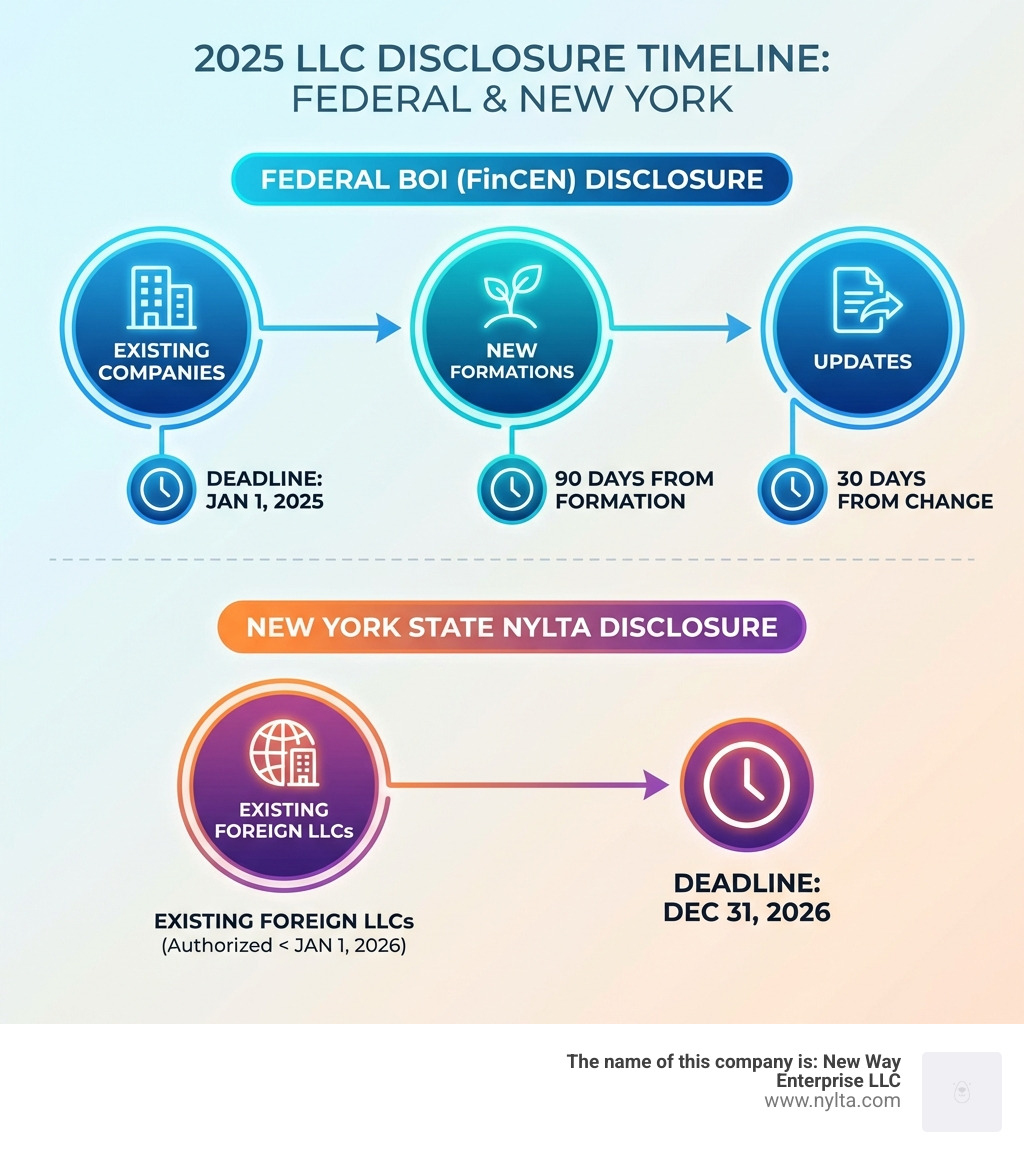
As of the latest guidance from the New York State Department of State’s website, the NYLTA effective date has been deferred to January 1, 2026. Perhaps more importantly, the scope has been narrowed. While the law initially seemed to apply to all LLCs, it is now confirmed that the NYLTA reporting requirements apply only to foreign LLCs (those formed in a foreign country) that are authorized to do business in New York.
Domestic LLCs (those formed in New York) and LLCs formed in other U.S. states (like Delaware or Florida) are currently exempt from NYLTA reporting, though they must still comply with the federal CTA.
NYLTA Specific Requirements for Foreign LLCs:
Initial Filing: Must file a BOI disclosure or an attestation of exemption.
Annual Requirement: Unlike the federal rule (which only requires updates when info changes), NYLTA requires an annual statement to confirm or update information.
Affirmative Exemptions: If you claim an exemption, you must actually file an "attestation of exemption" with the state. Under federal law, you simply don't file if you are exempt.
Public Record vs. Privacy: While the BOI itself is not public, the fact that a company has filed (or is past due) is part of the public database.
Key Differences Between NYLTA and Federal Rules
Navigating both federal and state laws can feel like playing two different games at once. The biggest difference is the "Affirmative Exemption" rule. Under the federal CTA, if your LLC meets one of the 23 exemptions (like being a large operating company), you simply don't file a report. In New York, you must proactively file a statement with the Department of State identifying which exemption you are claiming.
Furthermore, the federal government does not require an annual "check-in." You only file an updated report if something changes (like a member moving to a new house or selling their interest). New York's system requires an annual filing to ensure the state's records remain current. For those of us managing multiple entities, this means 2026 will bring a significant administrative workload.
California and Other State Reporting Cycles
New York isn't the only state with its own llc disclosure requirements, though most other states focus on "Statements of Information" rather than beneficial ownership.
In California, for instance, LLCs must file a Statement of Information within 90 days of formation and then every two years (biennially) thereafter. This filing carries a $20 fee and requires basic info like the names of managers and the agent for service of process. Failure to file on time results in a $250 penalty and potential suspension of the LLC's powers. You can find the specific California LLC filing instructions on the Franchise Tax Board and Secretary of State websites.
Other states have much longer cycles. Pennsylvania, for example, operates on a 10-year cycle for its decennial filings. Understanding these state-specific rhythms is essential for maintaining "Good Standing," which is often a requirement for securing loans or selling a business.
Deadlines and Penalties for LLC Disclosure Requirements
The clock is ticking for many business owners. Because the federal CTA rules have been in effect since early 2024, many of the initial "grace periods" are ending. We cannot stress enough how important it is to mark these dates in your calendar.
Existing LLCs (Formed before Jan 1, 2024): The federal deadline was January 1, 2025. If you haven't filed your BOI report yet, you are technically in violation of federal law.
New LLCs (Formed in 2024): You had 90 calendar days from the date of formation or registration to file your initial federal BOI report.
New LLCs (Formed in 2025 and 2026): The window shrinks to 30 calendar days from formation.
Updates and Corrections: If any information in your report changes (a beneficial owner changes their legal name, address, or ID document), you must file an updated report within 30 days. If you discover an error in a previous filing, you have 30 days to correct it.
Federal Civil and Criminal Consequences
The federal government has "teeth" when it comes to enforcement. Willfully failing to report complete or updated beneficial ownership information to FinCEN, or willfully providing false information, can lead to:
Civil Penalties: Fines of up to $500 for each day that the violation continues.
Criminal Penalties: Fines of up to $10,000 and/or imprisonment for up to two years.
FinCEN has stated they will focus on "willful" non-compliance, but the definition of willful can be broad. Ignoring the requirement after receiving multiple notices or failing to set up a system for monitoring changes in ownership could put you at risk.
Penalties for Non-Compliance with LLC Disclosure Requirements in New York
New York's penalties are equally structured to encourage compliance. If a foreign LLC fails to file its required BOI disclosure or attestation of exemption with the NYDOS, the consequences include:
Past Due Status: After 30 days of non-filing, the LLC's status will be marked as "past due" in the state's records.
Suspension of Authority: If the delinquency is not cured, the LLC's authority to do business in New York can be suspended.
Monetary Fines: For delinquency exceeding two years, the state can levy a fine of up to $500 per day.
Reinstatement Fee: To remove a "Suspended" status and return to good standing, the LLC must pay a $250 penalty in addition to filing the missing reports.
How to File Your Beneficial Ownership Information (BOI) Report
Filing your BOI report doesn't have to be a nightmare, but it does require preparation. You will need to gather high-quality images of identification documents for every beneficial owner.
Step-by-Step Filing Process:
Gather Data: Collect the full legal name, date of birth, and residential address for all owners with 25% stake or substantial control.
Capture IDs: Take clear photos or scans of a non-expired U.S. passport, state driver's license, or foreign passport (if no U.S. ID exists).
Access the Portal: Visit the FinCEN BOI E-Filing website and select "File BOIR."
Enter Company Info: Provide the LLC's legal name, any DBAs, the U.S. address of the principal place of business, and the EIN.
Submit and Confirm: After entering all owner and applicant data, submit the form. You should receive a confirmation transcript which you must keep for your records.
While there are no federal filing fees paid to FinCEN, many business owners use third-party service providers to manage the process. These providers can help verify that you've identified all necessary beneficial owners and provide a secure vault for ID documents, which is often safer than keeping copies on a local office computer.
Frequently Asked Questions about LLC Disclosures
Is there a fee for filing federal BOI reports?
No, FinCEN does not charge a fee for submitting a Beneficial Ownership Information report. However, you should distinguish this from state-level requirements. For example, California charges a $20 fee for its biennial Statement of Information. If you use a third-party service provider to handle your federal or state filings, you will also pay their service charges, which vary based on the level of monitoring and support provided.
Do inactive LLCs need to file disclosure reports?
It depends. Under federal law, an "inactive entity" is exempt only if it meets six strict criteria: it was in existence on or before January 1, 2020; it is not engaged in active business; it is not owned by a foreign person; it has not had any change in ownership in the last 12 months; it has not sent or received more than $1,000 in the last 12 months; and it holds no assets. If you have an old "shelf" LLC that you haven't used but it holds a bank account or a piece of land, it is not exempt and must file.
Can a third-party service provider file on my behalf?
Yes. FinCEN and state agencies allow authorized third-party providers to file reports. This is often the preferred route for businesses with complex structures or those who want to ensure they don't miss the 30-day update window. These platforms often provide automated status assessments and tracking of ongoing NYDOS guidance, which is vital as state laws continue to evolve.
Conclusion
The era of anonymous LLC ownership is effectively over. Between the federal Corporate Transparency Act and the New York LLC Transparency Act, the llc disclosure requirements in 2026 demand a proactive compliance strategy. For most business owners, the risk of a $500-per-day fine far outweighs the effort required to file a simple disclosure.
We recommend conducting a "compliance audit" of all your business entities. Identify which ones are reporting companies, who the beneficial owners are, and whether any of your foreign LLCs are authorized to do business in New York. The federal deadline for existing companies has already passed, and the New York requirements will be here before we know it.
At New Way Enterprise LLC, we understand that these regulations can feel overwhelming. Staying on top of every update from FinCEN and the NYDOS is a full-time job. To simplify your life and protect your business, consider utilizing Automated NYLTA compliance and monitoring services. Our partners at NYLTA.com provide the state's first dedicated platform for automated status assessment and secure filings, ensuring you never miss a deadline or face a delinquency penalty. Stay compliant, stay transparent, and keep your focus on growing your business.