How to Navigate LLC Exemption Requirements Without a Headache
Why LLC Exemption Requirements Matter for Your Business
LLC exemption requirements vary dramatically depending on where your business operates and how you've structured your tax elections. Understanding these requirements is critical because missing exemptions can cost you thousands in unnecessary taxes—while missing compliance deadlines can trigger penalties that reach $592 per day.
Quick Answer: Key LLC Exemption Categories
Federal Tax Exemptions - LLCs can file Form 1023 for 501(c)(3) status but will be treated as corporations, not disregarded entities
State Annual Tax Exemptions - California offers first-year exemption (2021-2023), 15-day exception, and deployed military exemptions from the $800 annual tax
Cross-Border Treaty Exemptions - US LLCs operating in Canada may access treaty benefits through look-through rules and Form NR303
Property Tax Exemptions - Manufacturing LLCs may qualify for machinery exemptions in states like Massachusetts
Regulatory Exemptions - Foreign LLCs operating specialized platforms (like ATS systems) may obtain exemptions from marketplace rules
The challenge? LLCs are what tax professionals call "tax chameleons"—they can be treated as partnerships, disregarded entities, C corporations, or S corporations for federal purposes. Each classification opens different exemption doors while closing others.
For foreign LLC owners authorized to do business in New York, the stakes are even higher. The New York LLC Transparency Act (NYLTA) has introduced new beneficial ownership disclosure requirements with severe penalties for non-compliance. Meanwhile, if you're conducting business across borders—particularly between the US and Canada—you're navigating multiple tax jurisdictions where the Canada Revenue Agency (CRA) treats your LLC differently than the IRS does.
This guide breaks down the exemption landscape so you can identify which requirements apply to your specific situation, avoid costly mistakes, and maintain compliance without the legal headaches.
Understanding Federal and State LLC Exemption Requirements
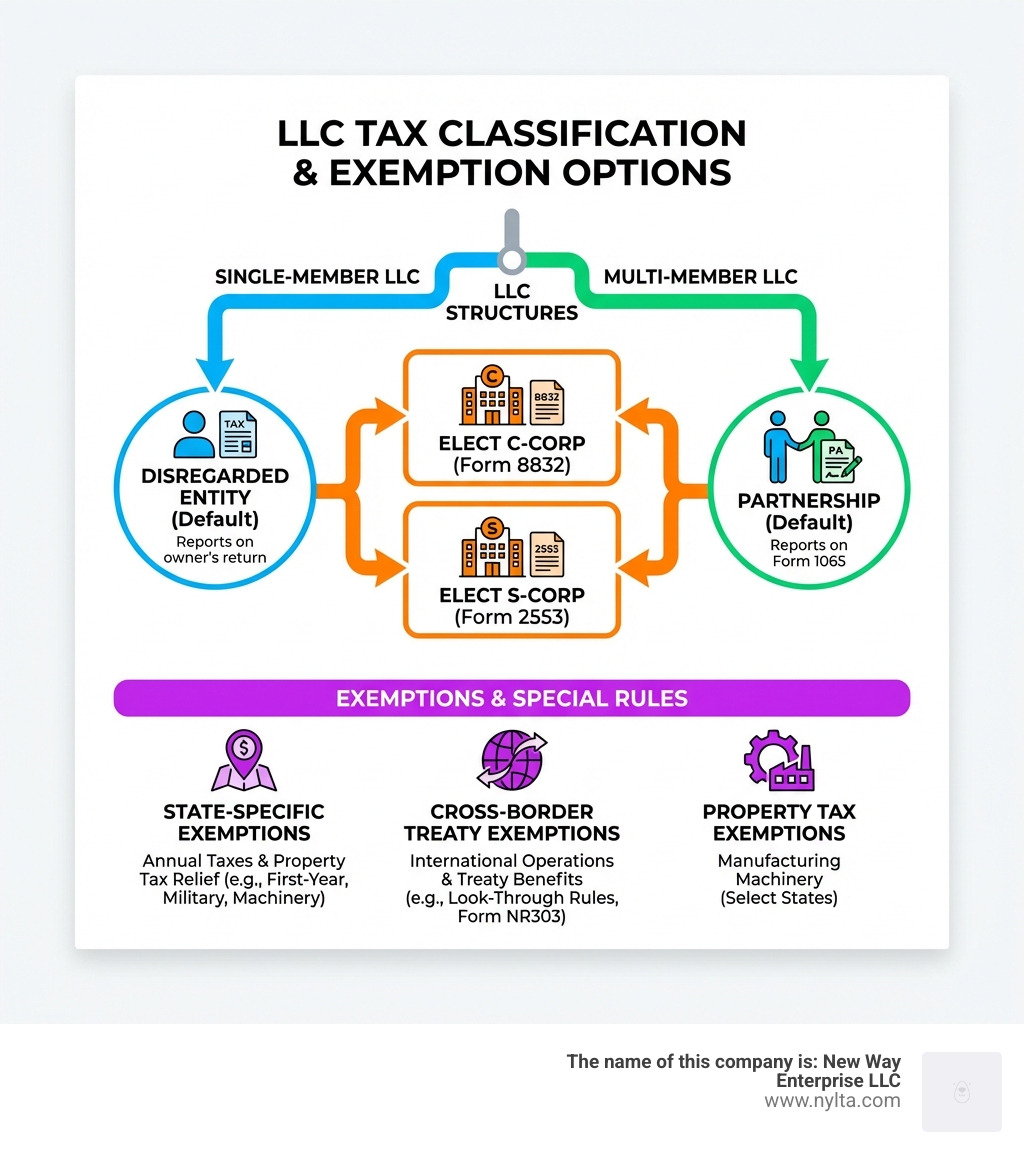
When we talk about an LLC, we are talking about a legal entity created under state law. However, the IRS doesn’t have a specific "LLC" tax category. Instead, they let you choose your costume. By default, a single-member LLC is a "disregarded entity" (reporting on the owner's tax return), and a multi-member LLC is a partnership.
To change this, you use Form 8832 (Entity Classification Election) to be taxed as a C corporation, or Form 2553 to elect S corporation status. These elections are the foundation of your LLC exemption requirements; you can't claim certain corporate exemptions if you're taxed as a partnership, and vice versa.
California R&TC 17946 and LLC exemption requirements
California is famous for its $800 annual franchise tax, which applies to every LLC doing business in the state—even if you aren't making a profit. However, there are several ways to keep that money in your pocket:
The First-Year Exemption: Under Assembly Bill 85, LLCs organized or registered in California between January 1, 2021, and December 31, 2023, are exempt from the $800 annual tax for their first taxable year. This was a massive win for small businesses during the pandemic recovery.
The 15-Day Exception: According to R&TC 17946, an LLC is not subject to the annual tax if it conducted no business in the state during the taxable year AND the taxable year was 15 days or less. This is perfect for businesses that formed at the very end of December.
Deployed Military Exemption: We see this help many service members. A small business LLC (with $250,000 or less in CA income) that is solely owned by a deployed member of the US Armed Forces can qualify for an exemption if the business operates at a loss or ceases operations during the deployment.
Short-Form Cancellation: If you started an LLC but realized it wasn't for you, filing a short-form cancellation (Form LLC-4/8) within 12 months of organizing can sometimes help you avoid that first-year tax if no business was conducted and no debts are owed.
Massachusetts property tax and LLC exemption requirements
In Massachusetts, LLC exemption requirements take a turn toward physical assets. If your LLC is treated as a corporation for tax purposes and is involved in manufacturing, you might be eligible for significant personal property tax relief.
Under Massachusetts GL c. 59, manufacturing corporations are generally exempt from local taxation on their machinery. To qualify, your LLC must appear on the Department of Revenue’s annual list of authorized corporations. If you're an out-of-state LLC, you must be registered with the Secretary of the Commonwealth to even get in the running for these machinery exemptions.
State Primary LLC Exemption/Exception Key Requirement California First-Year Tax Waiver Registered between 2021-2023 California 15-Day Rule No business conducted; year < 15 days Massachusetts Machinery Exemption Must be classified as "Manufacturing" New York NYLTA Exemptions Must meet 1 of 23 specific categories
Navigating Tax-Exempt Status and Form 1023
Can an LLC actually be a non-profit? Yes, but it’s a bit like threading a needle. If an LLC wants to be recognized as a 501(c)(3) organization, it must file Form 1023.
However, there is a major "gotcha" here. According to the IRS LLC Guide Sheet, an LLC that files Form 1023 is automatically treated as a corporation for federal tax purposes. It can no longer be a disregarded entity.
For an LLC to qualify for 501(c)(3) status, the IRS Publication 3402 outlines strict organizational tests:
Member Restrictions: All members of the LLC must be 501(c)(3) organizations or governmental units.
Purpose Clause: The operating agreement must limit the LLC’s activities to one or more exempt purposes.
Dissolution Clause: The documents must permanently dedicate the LLC's assets to a charitable purpose if the entity shuts down.
If your LLC is owned by a single tax-exempt parent organization, it is often better to remain a "disregarded entity." In this case, the LLC doesn't file its own Form 1023; instead, its activities are treated as a branch of the parent organization. We recommend checking your organizational documents carefully before filing, as electing corporate status is usually a one-way street for 60 months.
Cross-Border LLC Exemption Requirements: The Canada-US Connection
Operating a US-based LLC in Canada is a classic "tax trap." The main issue is that while the US sees your LLC as a pass-through (partnership/disregarded), the Canada Revenue Agency (CRA) sees it as a corporation under the Income Tax Act.
This mismatch creates a problem: the Canada-US Tax Treaty generally grants benefits to "residents." Since a standard LLC doesn't pay its own taxes in the US, the CRA argues the LLC itself isn't a "resident" of the US.
How to Access Treaty Benefits
To bridge this gap and meet LLC exemption requirements for treaty benefits, you must use the "Look-Through Rule." This allows the LLC to claim treaty benefits (like reduced withholding taxes) to the extent that its members would have been entitled to those benefits if they had earned the income directly.
Form NR303: This is the "Declaration of Eligibility for Benefits Under a Tax Treaty for a Hybrid Entity." The LLC must file this to claim that its members are US residents entitled to treaty relief.
Limitation on Benefits (LOB): To prevent "treaty shopping," the LLC must prove its members are "qualifying persons"—usually meaning they are natural persons or publicly traded companies in the US.
Branch Tax Exemption: US LLCs operating in Canada face a "branch tax" (essentially a tax on profits not reinvested in Canada). However, the treaty provides an exemption for the first $500,000 CDN of earnings.
Lifetime Capital Gains Exemption (LCGE) for LLCs
If you are a Canadian resident holding shares in a "Small Business Corporation," you might be eligible for the Lifetime Capital Gains Exemption. As of June 25, 2024, the LCGE limit increased to $1.25 million, indexed to inflation.
For 2024, the exemption for qualifying shares is $1,016,836, which allows you to deduct up to $508,418 of taxable capital gains. This applies to the sale of shares, not assets. Because the CRA treats an LLC as a corporation, if you are a Canadian resident selling interests in a US LLC that qualifies as a small business, you may be able to use Line 25400 Capital Gains deductions, but the inclusion rate for gains above certain thresholds has recently increased to 66.7%.
Regulatory and Industry-Specific Exemptions
Beyond taxes, LLC exemption requirements often pop up in highly regulated industries like finance and securities. A great example of this is how foreign LLCs operate Alternative Trading Systems (ATS) in Canada.
Marketplace Rules and ATS Exemptions
In Canada, entities operating marketplaces are usually subject to strict "Marketplace Rules" (NI 21-101). However, foreign LLCs—especially those already regulated by the US SEC and FINRA—can apply for exemptions. For instance, an LLC might be exempted if:
Its Canadian securities volume constitutes less than 10% of its global volume.
It only provides access to "permitted clients" (institutional investors with significant assets).
It demonstrates that US SEC Regulation ATS provides equivalent protection to Canadian laws.
AML and FINTRAC Considerations
If your LLC acts as a "financial entity" or a "money services business," you fall under the PCMLTFA (Proceeds of Crime (Money Laundering) and Terrorist Financing Act).
Exemptions here are rare but specific. For example, certain reporting requirements are waived for "very large corporations" with net assets of at least $75 million CAD on their last audited balance sheet. However, most LLCs must identify "Beneficial Owners"—anyone who owns or controls 25% or more of the entity. Failure to screen these individuals against the Consolidated Sanctions List can lead to Criminal Code violations.
Compliance Strategies for LLC Reporting and Transparency
If you operate in New York, the most urgent LLC exemption requirements you face right now involve the New York LLC Transparency Act (NYLTA). Much like the federal Corporate Transparency Act, the NYLTA requires LLCs to disclose their beneficial owners to the state.
However, the NYLTA provides 23 specific exemption categories. These include:
Large operating companies (more than 20 full-time employees and $5M in gross receipts).
Publicly traded companies.
In-active entities (formed before a certain date with no assets/business).
Regulated financial institutions and insurance companies.
At New Way Enterprise LLC, we know that determining if you fit into one of these 23 buckets is the "headache" part of the process. Even if you are exempt, you must still file an Exemption Affirmation with the New York Department of State (NYDOS).
To stay compliant, we recommend a three-step strategy:
Risk Assessment: Use the PCMLTFR Definitions to identify who actually counts as a "beneficial owner" in your structure.
Automated Monitoring: Use platforms like NYLTA.com to track NYDOS guidance updates. Regulations change, and an exemption you qualify for today might have different filing requirements tomorrow.
Documentation: Keep a "compliance binder" that includes your Form 8832 elections, your membership ledger, and any filed exemption affirmations.
Frequently Asked Questions about LLC Exemptions
Can an LLC file Form 1023 for tax-exempt status?
Yes, but doing so changes the LLC's tax DNA. By filing Form 1023, the LLC elects to be treated as a corporation rather than a partnership or disregarded entity. It must also meet the "organizational test," ensuring its members are other 501(c)(3) organizations or government entities.
What is the 15-day annual tax exception for LLCs?
In California, this exception allows an LLC to skip the $800 annual tax if it was only in existence for 15 days or less during the tax year and did not conduct any business in the state. This is a common relief for businesses that register in mid-to-late December but don't start operations until January.
How do US LLCs access Canada-US Tax Treaty benefits?
Because the CRA views LLCs as corporations, the LLC must file Form NR303. This allows the LLC to "look through" to its members. If the members are US residents, the LLC can claim the reduced treaty rates for dividends, interest, and royalties on their behalf.
Conclusion
Navigating LLC exemption requirements doesn't have to be a source of constant stress. Whether you're looking for the California first-year tax waiver, a Massachusetts machinery exemption, or a cross-border treaty benefit, the key is knowing your entity's tax classification and staying ahead of state-specific filings.
For those dealing with the complexities of the New York LLC Transparency Act, the stakes are high, but the tools are better than ever. At New Way Enterprise LLC, we understand that your time is better spent growing your business than deciphering legislative text.
If you need help determining your status or handling your filings, we recommend exploring automated NYLTA compliance services. By leveraging technology for compliance review and secure filing, you can ensure your LLC remains in good standing while you focus on what you do best.