
Everything You Need to Know About the New York LLC Transparency Act
Understanding New York's New LLC Disclosure Requirements
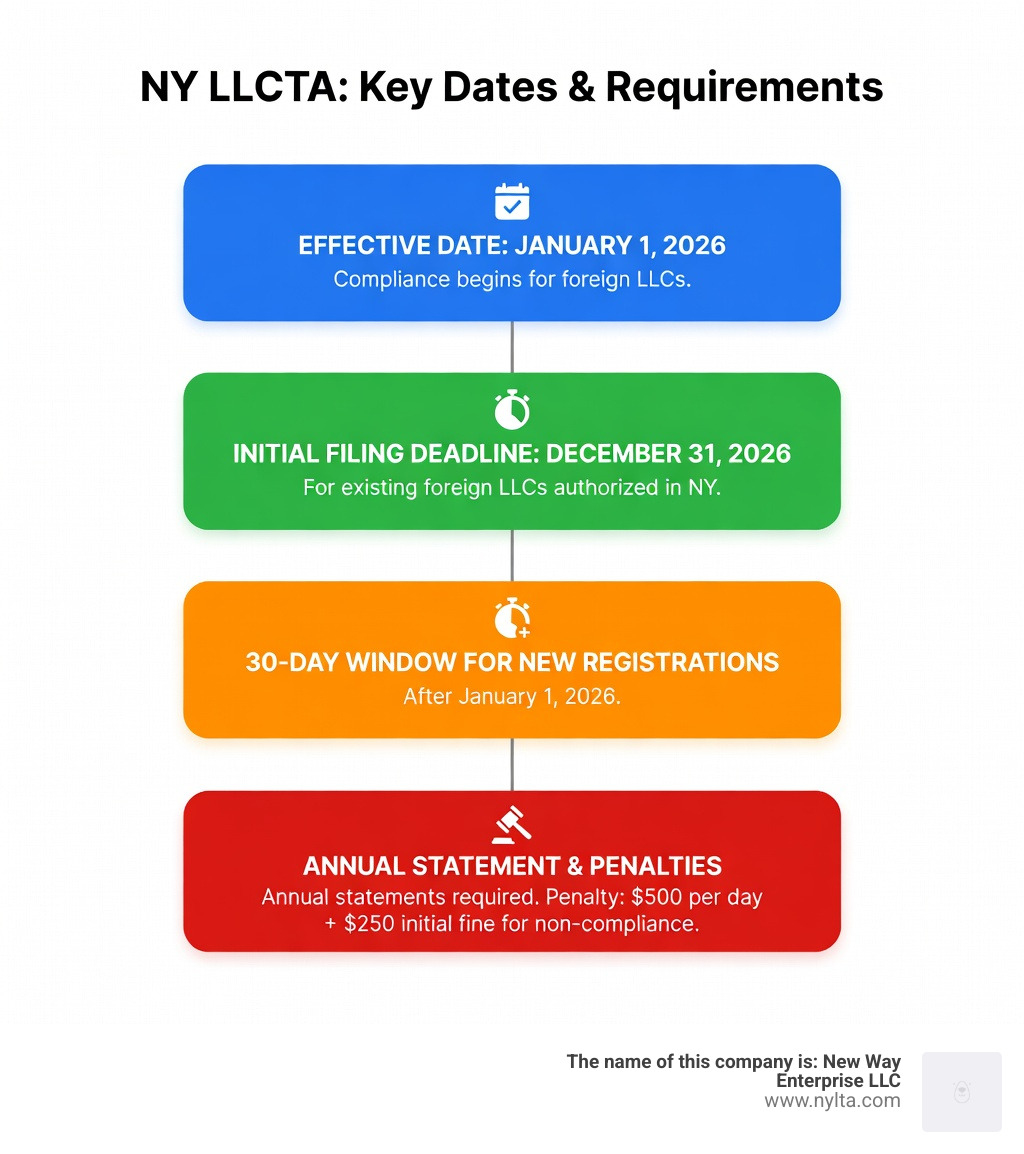
The llc transparency act new york requires foreign limited liability companies authorized to do business in New York to disclose their beneficial owners to the state starting January 1, 2026. Here's what you need to know:
Quick Facts:
Effective Date: January 1, 2026
Who Must File: Foreign (non-US) LLCs authorized in New York
Filing Deadline: December 31, 2026 for existing entities; 30 days for new registrations
Annual Requirement: Yes, annual statements required
Penalties: Up to $500 per day plus $250 initial fine
Information Protected: Confidential database, not public
On December 19, 2025, Governor Kathy Hochul vetoed legislation that would have expanded the New York LLC Transparency Act (NY LLCTA) to include all US-formed LLCs. Due to this veto and a federal rule change by FinCEN in March 2025, the Act now applies only to foreign LLCs—those formed under the laws of other countries—that are authorized to conduct business in New York.
This narrowed scope came as a surprise to many businesses and legal experts. The original legislative intent was to combat money laundering, tax evasion, and fraud by requiring disclosure of who actually owns and controls LLCs operating in the state. Governor Hochul stated in her veto message that imposing requirements beyond federal standards was not in New York's interest.
What makes the NY LLCTA different from federal rules? Even exempt LLCs must file annual attestations with the New York Department of State, unlike the federal Corporate Transparency Act where exempt entities don't file at all. The state also requires annual updates instead of the federal 30-day change notifications.
If you operate a foreign LLC in New York, understanding these requirements isn't optional—failure to comply triggers automatic penalties and can lead to suspension of your authority to do business in the state.
Understanding the LLC Transparency Act New York
Navigating the legal landscape in the Empire State can sometimes feel like trying to find a specific seat in a crowded Yankee Stadium—confusing and a bit overwhelming! But we’re here to help clear the air. The llc transparency act new york (NY LLCTA) is a significant piece of legislation codified under NY LLC Law §§1106-1108.

Originally, the act was much broader. However, the current version we are preparing for in 2026 is the result of a complex legislative compromise. The most critical update came when Governor Hochul vetoed SB S8432. This veto effectively decoupled New York’s requirements from some of the broader federal reach, focusing the state’s energy specifically on "Foreign Reporting LLCs."
What does "foreign" mean in this context? It doesn't just mean "out of state" (like a Delaware LLC); it specifically refers to LLCs formed under the laws of a foreign country that have sought authorization to do business within New York. This alignment with FinCEN definitions ensures that the state isn't over-burdening domestic businesses while still maintaining a sharp eye on international entities that might be used for illicit activities like money laundering or terrorism financing.
The New York Department of State (NYDOS) is the primary oversight body here. They are responsible for collecting this data and maintaining the database. While the law aims for transparency, it’s a "behind-the-scenes" kind of transparency—meaning the information isn't for the general public but for law enforcement and regulatory agencies.
Beneficial Ownership and Reporting Requirements
If your entity falls under the llc transparency act new york, you need to know exactly who needs to be "unmasked." The law focuses on two main groups: Beneficial Owners and Company Applicants.
Who is a Beneficial Owner?
Under the NY LLCTA, we use two primary tests to identify a beneficial owner, mirroring the federal FinCEN Small Entity Compliance Guide:
The Substantial Control Test: This includes anyone who has significant influence over the company’s decisions. This usually covers senior officers (like a CEO, CFO, or General Counsel), managing members, or anyone who can appoint or remove senior officers.
The 25% Ownership Threshold: This is the math portion of the program. Anyone who directly or indirectly owns or controls at least 25% of the ownership interests in the LLC must be reported.
What Information Must Be Reported?
For every beneficial owner and up to two company applicants, you must provide:
Full legal name
Date of birth
Current home or business address (Note: NY allows business addresses, whereas the federal CTA often prefers residential)
A unique identifying number from an unexpired passport, state driver’s license, or other government-issued ID.
One interesting quirk of the New York law: unlike the federal requirement, you currently do not need to upload an image of the ID document, though you must provide the number accurately. All this data goes into a confidential database. This was a major point of contention during the bill's drafting. The original version of the act contemplated a public database, but privacy concerns won out. Now, the information is only accessible via court order or to law enforcement agencies for official duties.
Filing Deadlines for the LLC Transparency Act New York
Timing is everything in New York—whether you're catching the subway or filing state documents. The llc transparency act new york officially takes effect on January 1, 2026. However, your specific deadline depends on when your LLC was authorized to do business in the state.
Existing LLCs: If your foreign LLC was authorized to do business in New York before January 1, 2026, you have a one-year grace period. Your initial Beneficial Ownership Information (BOI) report must be filed by December 31, 2026.
New LLCs: For any foreign LLC that files for authorization on or after January 1, 2026, the clock ticks much faster. You must file your BOI report within 30 days of your registration being approved.
Annual Requirements: This is where New York differs significantly from the federal government. While the federal CTA requires updates only when information changes, New York requires annual statements. These filings confirm your information is still accurate or provide necessary updates.
We recommend marking these dates in red ink. Missing a deadline by even a few days can move your company into "past due" status, which is a headache no business owner needs.
Exemptions and Mandatory Annual Attestations
Not every foreign LLC has to disclose its owners. The llc transparency act new york adopts the same 23 exempt categories found in the federal CTA.
Common exemptions include:
Large Operating Companies: Entities with more than 20 full-time employees in the US, a physical office in the US, and over $5 million in gross receipts.
Publicly Traded Companies: Entities already regulated by the SEC.
Inactive Entities: LLCs that aren't engaged in active business and meet specific ownership and asset criteria.
Comparison of NY LLCTA and Federal CTA Requirements
Feature Federal Corporate Transparency Act New York LLC Transparency Act Entity Scope Most domestic and foreign entities Foreign (non-US) LLCs only Exempt Entities No filing required Must file Annual Attestation Update Frequency Within 30 days of any change Annual Statement Reporting Authority FinCEN (Federal) Department of State (NY) Penalty Basis Willful failure to report Failure to file (automatic status change)
The Big Catch: In the federal system, if you are exempt, you simply don't file. In New York, the NYDOS Beneficial Owner Disclosure rules require you to proactively tell them you are exempt. You must file an Annual Attestation of Exemption signed under penalty of perjury. This statement must specify which of the 23 exemptions you are claiming and provide the factual basis for that claim.
Penalties for Non-Compliance with the LLC Transparency Act New York
New York doesn't play around when it comes to compliance. The penalties for ignoring the llc transparency act new york are designed to be persuasive, to say the least.
If an LLC fails to file its initial report or annual statement:
Past Due Status: After 30 days of missing a deadline, the entity is marked as "past due."
Financial Fines: The state can levy a $250 initial fine. More significantly, the New York Attorney General can impose a penalty of up to $500 per day for each day the report is late.
Delinquency and Suspension: If the failure to file continues for two years, the LLC is marked as "delinquent." This can lead to the suspension of your authority to do business in New York or even the involuntary dissolution of the entity.
The "Cure": To fix a delinquent or suspended status, you must file the missing reports and pay a $250 restoration fee, along with any accrued daily fines.
There is a small silver lining: a 90-day safe harbor. If you realize you've submitted inaccurate information, you can file a corrected report within 90 days of the original submission without facing penalties, provided the error wasn't intentional.
Frequently Asked Questions about the NY LLCTA
Is beneficial ownership information public in New York?
No. While there was a lot of buzz about a public "wall of shame" for LLC owners, the final version of the New York LLC Transparency Act ensures that BOI is kept in a secure, non-public database. It is only accessible to law enforcement, government agencies, or via a specific court order. Your privacy is protected from the general public and nosy competitors.
How does the NY LLCTA differ from the federal CTA?
There are three major differences:
Exemptions: The federal CTA doesn't require exempt companies to file anything. New York requires an annual attestation.
Updates: The federal CTA requires updates within 30 days of any change. New York uses an annual statement system.
Scope: After the 2025 veto, the NY LLCTA focuses on foreign (non-US) LLCs, whereas the federal CTA covers almost all domestic corporations and LLCs.
Which entities are subject to the LLC Transparency Act New York?
Currently, the law applies to Foreign Reporting LLCs. These are limited liability companies formed under the law of a foreign country that are authorized to do business in New York. Because of Governor Hochul's veto of the expansion bill, domestic New York LLCs and LLCs formed in other US states (like Delaware) are currently not required to file BOI reports under this specific New York act, though they still have federal CTA obligations.
Conclusion
The llc transparency act new york represents a new era of corporate accountability in the Empire State. While the scope has been narrowed to foreign entities, the filing requirements are strict, and the annual nature of the reports means compliance is an ongoing task, not a one-time event.
Staying on top of these changes is vital for any international business operating in New York. We know that tracking NYDOS guidance and managing secure filings can be a full-time job. That’s why we’re here to help. At New Way Enterprise LLC, we specialize in making complex legal requirements simple.
If you want to ensure your foreign LLC remains in good standing without the stress of $500-a-day fines, check out our Secure NY LLCTA Compliance Services. We offer automated status assessments and secure filing for both disclosures and exemptions, keeping your business running smoothly while we handle the paperwork. Don't let a 30-day window catch you off guard—start your compliance review today!