NY State of Mind: Meeting Your LLC Transparency Deadlines
Understanding New York's New LLC Transparency Requirements
LLC transparency act requirements in New York mandate that most LLCs disclose their beneficial ownership information to the New York Department of State (NYDOS) starting January 1, 2026. Here's what you need to know:
Quick Reference: NY LLC Transparency Act Requirements
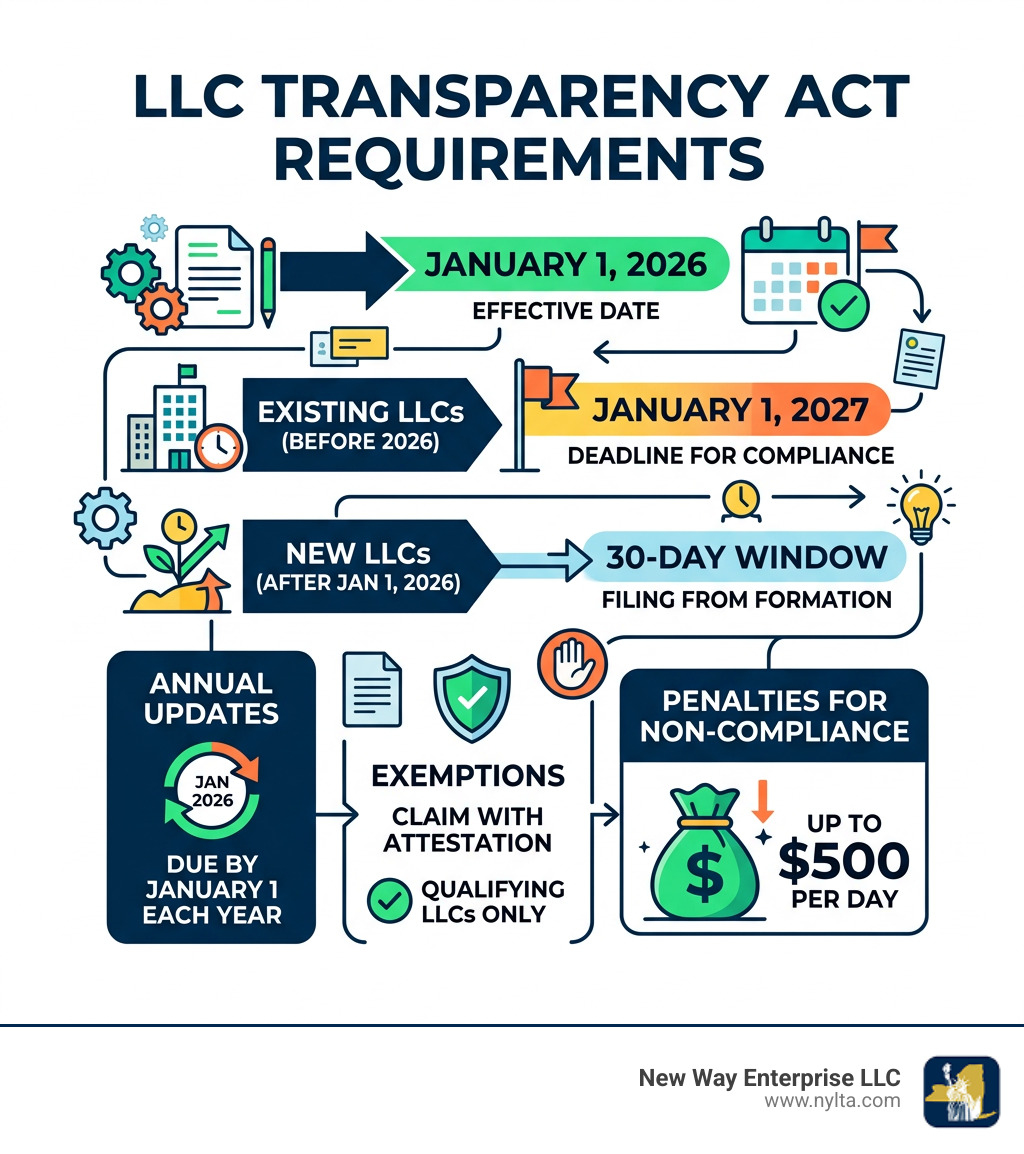
Requirement Details Effective Date January 1, 2026 Who Must File Foreign (non-U.S.) LLCs authorized in NY; domestic LLCs if amendments pass Initial Deadline January 1, 2027 (existing LLCs) or 30 days (new formations after Jan 1, 2026) What to Report Beneficial owner name, DOB, address, ID number Penalties Up to $500 per day for late filing; potential suspension or dissolution Annual Updates Required by January 1 each year Exemptions 23+ categories (must file exemption attestation)
If you own or operate an LLC in New York, you're facing a significant new compliance obligation. The New York LLC Transparency Act (NY LLCTA) represents one of the most substantial reporting changes for limited liability companies in decades.
The legislative journey has been turbulent. Originally enacted in December 2023 and amended in March 2024, the law was designed to mirror the federal Corporate Transparency Act. But when FinCEN issued an interim rule in March 2025 exempting domestic U.S. entities from federal reporting, New York's law was thrown into uncertainty.
The state legislature responded by passing Senate Bill 8432 to decouple the NY LLCTA from federal definitions. However, Governor Hochul vetoed key provisions in late 2025, dramatically narrowing the law's scope. As it currently stands, only foreign (non-U.S.) LLCs authorized to do business in New York face mandatory reporting obligations.
This means if your LLC was formed under the laws of another country and operates in New York, you're squarely in the crosshairs of this new requirement. Miss a deadline, and you could face fines of up to $500 per day, suspension of your authority to do business, and even dissolution proceedings by the Attorney General.
The stakes are high. The timelines are tight. And the rules are still evolving.
Understanding the New York LLC Transparency Act Requirements
At its core, the New York LLC Transparency Act is a legislative effort to pull back the curtain on anonymous shell companies. For years, the "anonymous LLC" has been a staple of New York real estate and high-finance transactions. While often used for legitimate privacy, lawmakers argued that this anonymity provided a shield for illicit activities like money laundering, tax evasion, and "bad actor" landlord practices.
The journey began with Senate Bill S995B, which sought to end the practice of anonymous ownership by defining "beneficial ownership" and requiring public disclosure. However, after significant pushback regarding privacy concerns, the law was amended by Senate Bill S8059. This amendment shifted the information from a public, searchable database to a secure, non-public database accessible only to law enforcement and government agencies.
The llc transparency act requirements are heavily modeled after the federal Corporate Transparency Act (CTA). The legislative intent is clear: to align New York's standards with the Financial Crimes Enforcement Network (FinCEN) to combat financial crimes. However, as we will see, New York has added several of its own unique twists—primarily in how we handle exemptions and annual reporting.
Who Must Comply: Domestic vs. Foreign LLCs
One of the most confusing aspects of the current legal landscape is determining exactly which entities need to file. Because the law has seen several iterations and a significant gubernatorial veto, the "who" has changed recently.
Under the version of the law originally passed, both domestic (NY-formed) and foreign (out-of-state or out-of-country) LLCs were included. However, following the 2025 legislative session and the introduction of New York State Senate Bill 2025-S8432, a major shift occurred.
The Current Scope (Post-Veto)
As of late 2025, the reporting obligations under the NY LLCTA apply primarily to foreign (non-U.S.) LLCs authorized to do business in New York. A "foreign LLC" in this specific context refers to an entity organized under the laws of another country, not simply an LLC from another U.S. state like Delaware or Florida.
Feature Federal CTA New York LLCTA Entities Covered Corporations, LLCs, and other filed entities LLCs only Domestic LLCs Currently exempt (per 2025 FinCEN rule) Currently exempt (per 2025 Veto) Foreign (Non-U.S.) LLCs Required to report Required to report Exemption Filing No filing required to claim Must file Exemption Report Update Frequency Within 30 days of any change Annual statement required
While domestic U.S. LLCs are currently breathing a sigh of relief due to the Governor's veto, we must stay vigilant. The legislature has shown a strong appetite for "decoupling" from federal definitions to ensure New York has its own robust database regardless of what happens with the suspended federal CTA. We recommend that all LLC owners monitor the status of S8432 closely, as future amendments could quickly pull domestic entities back into the fold.
Navigating Exemptions and Filing Obligations
If you think your LLC might be exempt, don't assume you can just sit back and do nothing. This is one of the biggest traps in the llc transparency act requirements.
Under the federal CTA, if you are exempt, you simply don't file. In New York, the rules are stricter. Exempt LLCs must affirmatively "claim" their exemption by filing an Exemption Report with the Department of State. This report must identify the specific exemption being relied upon and provide factual support for that claim, all signed under the penalty of perjury.
The 23 Exemptions
New York has adopted nearly all 23 exemptions found in the federal CTA. These generally cover entities that are already heavily regulated, such as:
Large Operating Companies: Entities with more than 20 full-time U.S. employees, a physical office in NY, and over $5 million in gross receipts or sales.
SEC-Regulated Entities: Publicly traded companies and registered broker-dealers.
Financial Institutions: Banks, credit unions, and insurance companies.
Tax-Exempt Nonprofits: 501(c) organizations.
Inactive Entities: Those in existence for over a year, not engaged in active business, and holding less than $1,000 in assets.
You can find the full, updated list of these categories on the NYDOS website. Even if you meet the criteria for a "Large Operating Company," you must still file your annual attestation to remain in good standing.
Defining Beneficial Owners and Company Applicants
If your LLC is a "reporting company" (meaning it's not exempt), you must disclose information about two types of individuals: Beneficial Owners and Company Applicants.
Who is a Beneficial Owner?
A beneficial owner is any individual who, directly or indirectly, meets either of these two criteria:
Substantial Control: This includes senior officers (CEO, CFO, General Counsel), individuals with the authority to appoint or remove officers, or "important decision-makers" who direct the company's trajectory.
25% Ownership Stake: Anyone who owns or controls at least 25% of the ownership interests of the LLC.
Who is a Company Applicant?
For LLCs formed or registered on or after January 1, 2026, you must also report the "Company Applicant." This is the individual who directly files the articles of organization or the application for authority, as well as the person primarily responsible for directing that filing.
What Information is Required?
For every beneficial owner and applicant, the LLC must provide:
Full legal name
Date of birth
Current street address (New York allows either a residential or business address, which is a key difference from the federal residential-only rule)
A unique identifying number from an acceptable government-issued ID (like a passport or driver's license)
Unlike the federal system, New York does not currently require you to upload an image of the ID document, but you must provide the number and the jurisdiction that issued it. Detailed filing instructions are available to help you navigate the electronic portal.
Deadlines and Penalties for Non-Compliance
Mark your calendars. The llc transparency act requirements come with very specific "drop-dead" dates that you cannot afford to miss.
Key Deadlines
Effective Date: January 1, 2026.
Existing LLCs: If your LLC was formed or authorized in NY before January 1, 2026, you must file your initial Beneficial Ownership Information (BOI) report or Exemption Report by January 1, 2027.
New LLCs: If formed or authorized on or after January 1, 2026, you have exactly 30 days from the date of formation/registration to file.
Annual Updates: Every LLC must file an annual statement by January 1 each year to confirm or update their status.
The Cost of Procrastination
New York is not playing around with enforcement. If you fail to file within the 30-day window, your entity will be marked as "past due" on the records of the Department of State. If the delinquency persists for more than two years, the status becomes "delinquent."
The Penalties Include:
Monetary Fines: Up to $500 for each day the filing is past due.
Suspension: The LLC’s authority to do business in New York can be suspended after a 30-day notice period.
Ineligibility for PTET: Non-compliant LLCs may lose their eligibility for the New York Pass-Through Entity Tax (PTET) deduction, which could result in a massive tax hit for owners.
Dissolution: The Attorney General has the authority to bring an action to dissolve or annul any LLC that is delinquent or has provided fraudulent information.
To clear a delinquent status, you must make the required filing and pay a $250 civil penalty.
Frequently Asked Questions about LLC Transparency Act Requirements
What are the specific LLC transparency act requirements for beneficial owners?
Beneficial owners must provide their full legal name, date of birth, and a current street address. A major advantage of the New York law is that it allows for a business street address to be used instead of a residential one, protecting the privacy of owners who do not wish to disclose their home address. Additionally, you must provide a unique ID number from a government-issued document. All this data is stored in a confidential database and is not available to the public.
How do LLC transparency act requirements differ from the federal CTA?
While they are cousins, they aren't twins. The federal CTA requires updates within 30 days of any change (like an owner moving house). New York's law instead requires an annual statement filed by January 1st. Furthermore, New York requires exempt entities to file an attestation, whereas the federal government does not. New York also limits its scope strictly to LLCs, whereas the CTA covers corporations and other entity types.
Is the reported information public or confidential?
This was a major point of contention during the legislative process. Initially, the bill proposed a public database. However, the enacted version ensures that all beneficial ownership information is confidential. It is housed in a secure database accessible only to law enforcement agencies, the Attorney General, and certain government departments for official duties. It can also be accessed via a court order. Beneficial owners with significant privacy concerns can also apply for a specific privacy waiver to ensure their information remains protected even from these limited disclosures.
Conclusion
The "NY State of Mind" regarding business ownership has shifted from total anonymity to mandatory transparency. Whether you are a foreign LLC operating in Manhattan or a local venture awaiting the next round of legislative updates, understanding the llc transparency act requirements is no longer optional—it's a core part of your business survival strategy.
Between the daily $500 fines and the risk of losing your "Good Standing" status, the cost of non-compliance far outweighs the effort of filing. We recommend that all LLC owners begin auditing their internal structures now. Identify your beneficial owners, gather their ID information, and determine if you qualify for one of the 23 exemptions.
At New Way Enterprise LLC, we know that keeping up with shifting New York regulations can feel like a full-time job. That’s why we leverage platforms like NYLTA.com to stay ahead of the curve. As New York’s first dedicated platform for automated status assessment and secure filing, it provides the peace of mind you need to focus on growing your business while we handle the red tape.
Don't wait until the January 1, 2027 deadline is staring you in the face. Start your compliance journey today and ensure your LLC remains a vibrant, legal part of the New York business community. For more information or to begin your assessment, explore our automated filing and compliance services today.