The complete list of New York LLC exemptions
Why New York LLC Exemptions Matter for Your Business
New York LLC exemptions determine whether your limited liability company must file beneficial ownership information under the New York LLC Transparency Act (NYLTA), which took effect on January 1, 2026. Understanding these exemptions can save you from daily fines up to $500 and potential business suspension.
Quick Answer: Who is Exempt from NYLTA Reporting?
All U.S.-formed LLCs (including New York and out-of-state domestic LLCs) are currently exempt from NYLTA reporting requirements
Foreign LLCs (formed outside the United States) authorized to do business in New York must file unless they qualify for one of the 23 federal Corporate Transparency Act (CTA) exemptions
Exempt foreign LLCs must still file an exemption attestation with the New York Department of State, unlike the federal CTA
Large operating companies, SEC-regulated entities, banks, insurance companies, and nonprofit subsidiaries may qualify for exemptions
The NYLTA has had a controversial evolution since its inception. Originally modeled after the federal Corporate Transparency Act, the law was significantly narrowed when FinCEN issued an interim rule in early 2025 that exempted all domestic reporting companies from federal beneficial ownership disclosure. Governor Kathy Hochul's December 2025 veto of legislation that would have decoupled New York's definitions from federal law meant that the NYLTA automatically adopted this narrower scope.
For foreign LLC owners authorized to do business in New York, this creates a unique compliance landscape. While your domestic competitors face no state-level reporting burden, you must navigate exemption categories, filing deadlines, and potential penalties including past-due status after 30 days, delinquency notices after two years, and daily fines for prolonged non-compliance.
The stakes are real. Missing deadlines can result in your LLC being suspended from conducting business in New York, with a $250 penalty required just to remove past-due or delinquent status. Understanding which exemptions apply to your situation is the first step toward stress-free compliance.
Understanding the NY LLC Transparency Act (NYLTA)
The New York LLC Transparency Act, or NYLTA, was born out of a desire to pull back the curtain on the anonymous shell companies often used for money laundering, tax evasion, and other illicit activities. While it started with high ambitions to cover almost every LLC in the state, the legislative journey was anything but a straight line.
In mid-2025, New York lawmakers attempted to broaden the Act's coverage to include more domestic LLCs. However, Governor Kathy Hochul vetoed that bill (S.8432) in December 2025. Because the NYLTA's definitions were tied directly to the federal Corporate Transparency Act (CTA), a surprising thing happened: when federal regulations (FinCEN) changed in March 2025 to exempt U.S. companies from reporting, New York’s law effectively followed suit.
Currently, the Official NYDOS Beneficial Ownership Disclosure guidance clarifies that the reporting burden falls primarily on non-U.S. LLCs (foreign-country entities) authorized to do business in New York. If your LLC was formed in a foreign country and you've filed for authority to operate in New York, you are likely a "reporting company."
To comply, you must identify your "beneficial owners." These are individuals who meet either the substantial control test (managing members, senior officers, or key decision-makers) or the 25% ownership threshold (anyone owning or controlling at least 25% of the entity’s ownership interests). It is important to note that reporting companies are not required to report beneficial owners who are U.S. persons; the focus is strictly on non-U.S. individuals.
The 23 Federal Categories for New York LLC Exemptions
The NYLTA adopts the 23 conditions for exemption enumerated in the federal CTA. If your foreign LLC fits into one of these buckets, you are considered an "exempt company" in the eyes of New York. However, unlike the federal rule where exempt companies simply don't file, New York requires you to affirmatively tell them you are exempt.
Below is a comparison of how these exemptions function across the federal and state levels:
Feature Federal CTA New York NYLTA Domestic LLCs Exempt (per 2025 rule) Exempt Foreign LLCs Must file if non-exempt Must file if non-exempt Exemption Filing No filing required Must file Attestation Updating Info Within 30 days of change Annual Statement Public Access Strictly Confidential Confidential Database
Some of the most common new york llc exemptions include:
Large Operating Companies: Entities with more than 20 full-time U.S. employees, a physical office in the U.S., and over $5 million in gross receipts or sales.
SEC-Regulated Entities: Publicly traded companies and other entities registered with the SEC.
Inactive Entities: LLCs that have been in existence for over a year, are not engaged in active business, and have not sent or received more than $1,000 in the preceding 12 months.
Banks and Credit Unions: Heavily regulated financial institutions.
Insurance Providers: State-regulated insurance companies.
Public Utilities: Entities providing essential services like electricity or water.
For more detailed descriptions of these categories, we recommend reviewing the FinCEN Small Entity Compliance Guide.
How Domestic Entities Qualify for New York LLC Exemptions
You might be wondering, "I formed my LLC in Delaware, but I do all my business in Manhattan. Do I have to file?" The answer, as of now, is a resounding no.
Under the current interpretation of the law, "foreign" refers specifically to entities organized under the laws of another country, not just another state. U.S.-formed LLCs—whether they are domestic New York entities or "foreign" in the sense that they were formed in Delaware, Florida, or D.C.—are currently exempt from the NYLTA reporting obligations.
This shift occurred because the NYLTA remains tethered to federal definitions. When the FinCEN interim rule narrowed the scope of the CTA, it inadvertently narrowed the New York law as well. Unless the New York legislature passes new laws to "decouple" from the federal framework, domestic LLCs can breathe a sigh of relief. You can find the latest updates on this at the NYDOS Exemption Information page.
Special Rules for Nonprofit New York LLC Exemptions
Nonprofits often use LLCs as subsidiaries to hold real estate or manage specific programs. Most LLCs that are wholly owned by nonprofits are exempt from NYLTA reporting. This is known as the "subsidiary exemption."
To qualify, the parent organization must be a tax-exempt entity under Section 501(c) of the Internal Revenue Code, a political organization, or certain charitable trusts. According to research on nonprofit subsidiary exemptions, there are a few nuances to keep in mind:
Mixed Ownership: If an LLC is owned by a nonprofit and a for-profit partner (a joint venture), it generally does not qualify for the subsidiary exemption.
HOAs: Homeowners' associations exempt under Section 501(c)(4) are usually exempt, but those exempt under Section 528 often are not.
Revocation: If a nonprofit loses its tax-exempt status, its LLC subsidiaries have a 180-day grace period to comply with reporting requirements.
Filing Procedures and Deadlines for LLCs
If you’ve determined that your foreign LLC is not exempt, or even if it is exempt, you have paperwork to do. New York is unique in that it requires an affirmative claiming of your exemption. You cannot just stay silent; you must tell the Department of State why you don't have to report beneficial owners.
Deadlines to Remember
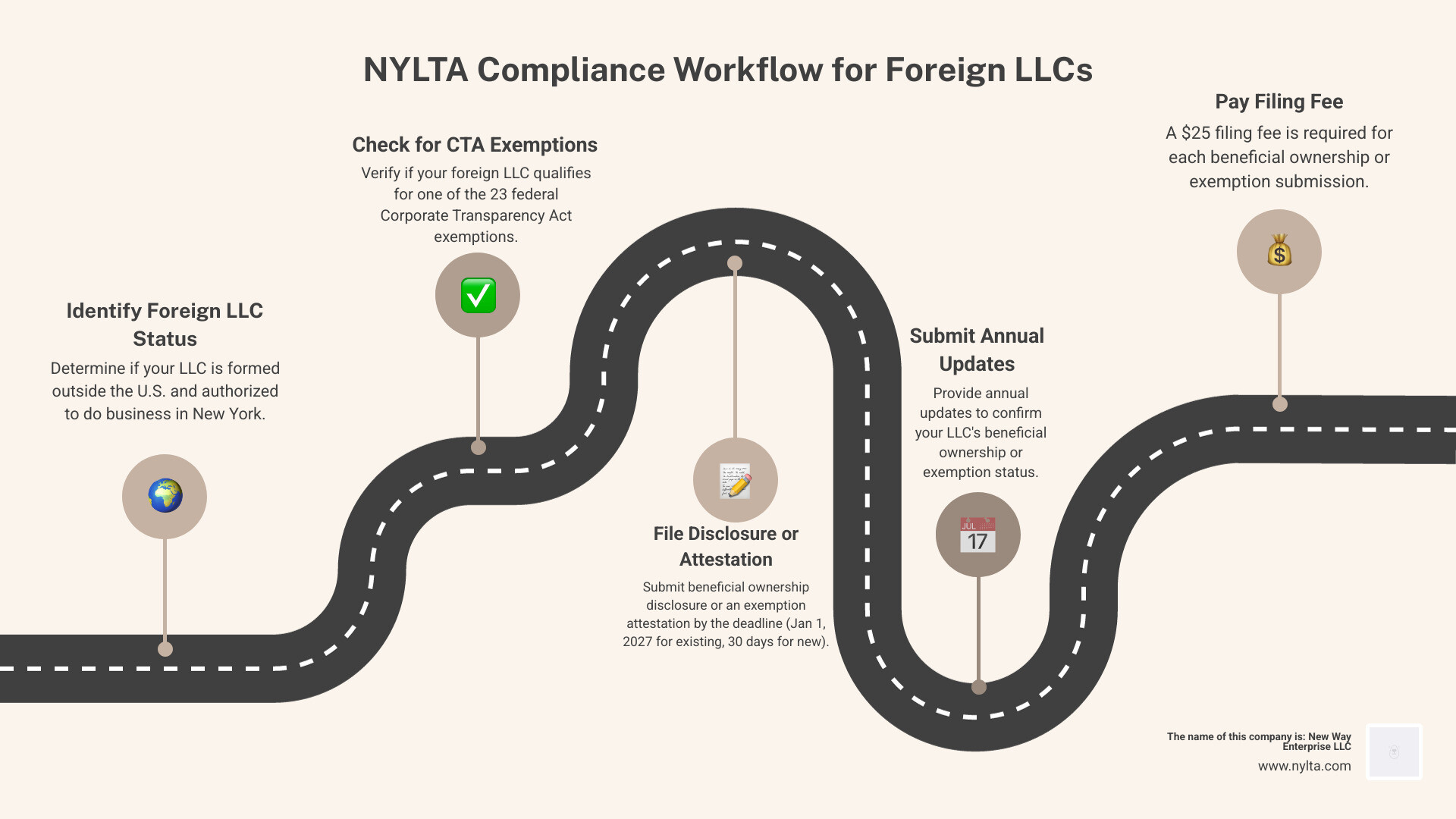
Existing LLCs: Foreign LLCs authorized to do business in NY before January 1, 2026, have until January 1, 2027, to file their initial disclosure or exemption attestation.
New LLCs: Entities authorized on or after January 1, 2026, must file within 30 days of their authorization.
What to File
The NYDOS filing instructions and forms outline the specific requirements. Currently, filings are submitted via PDF until a secure online portal is fully operational. Each filing—whether a disclosure or an exemption attestation—carries a $25 filing fee.
Once the initial filing is done, your work isn't over. You must file an annual statement confirming or updating your beneficial ownership information, residential or business address, and status as an exempt or reporting company. This is a significant difference from the federal CTA, which only requires updates when information actually changes.
Penalties for Missing New York LLC Exemptions Deadlines
New York doesn't take kindly to missed deadlines. If you fail to file your disclosure or attestation, your LLC will be marked as "past due" after 30 days. If the situation remains unresolved for two years, the Department of State will issue a delinquency notice.
Under NY Senate Law Section 1107, the consequences can escalate quickly:
Daily Fines: The Attorney General can impose fines of up to $500 per day for prolonged non-compliance.
Suspension of Authority: Your LLC could lose its legal authority to conduct business in the state. This means you might lose the ability to bring lawsuits in NY courts or maintain your "good standing" for contracts and loans.
Dissolution Risk: In extreme cases, the state can move to dissolve the entity entirely.
Reinstatement Fee: To remove a delinquent or past-due status, you must file the required documents and pay a $250 penalty to the NYDOS.
Frequently Asked Questions about NY LLC Reporting
Is beneficial ownership information public or confidential?
One of the biggest concerns for business owners is privacy. Initially, there was talk of making this information public, but that was changed. Under NY Senate Law Section 1106, beneficial ownership information is kept in a secure, nonpublic database.
The information is confidential and only accessible to:
Law enforcement agencies for official duties.
Government agencies (via court order or specific legal authorization).
The Department of State for administrative purposes.
Do exempt LLCs still have to file with the state?
Yes! This is the most common point of confusion. Under the federal CTA, if you are exempt, you do nothing. Under the NYLTA, if you are a foreign LLC and you are exempt, you must file an exemption statement. This sworn statement identifies the specific exemption you are claiming and provides the factual basis for that claim. You must also confirm this status annually.
What is the "Inactive Entity" exemption criteria?
To qualify for the "Inactive Entity" exemption, a foreign LLC must meet four strict criteria:
It was in existence on or before January 1, 2020.
It is not engaged in active business.
It is not owned, directly or indirectly, by any foreign person (this refers to non-U.S. persons).
It has not experienced a change in ownership or sent/received more than $1,000 in the last 12 months.
Conclusion
Navigating new york llc exemptions requires a proactive approach. While the current scope of the NYLTA is narrower than originally planned—sparing all domestic U.S. LLCs for now—foreign entities authorized in New York must act quickly to ensure they are compliant by the 2027 deadline.
At New Way Enterprise LLC, we understand that "legal tech" can sound intimidating, but it's really just about making your life easier. We recommend performing a thorough review of your entity structure and maintaining clear, digital records of all beneficial owners to avoid those nasty $500-a-day fines. By establishing a robust compliance strategy and consistent recordkeeping, you can ensure your business remains in good standing without the stress of last-minute filings.
For those looking for a more streamlined experience, NYLTA.com offers automated status assessments and secure filing services specifically designed for the New York LLC Transparency Act. By staying ahead of the regulatory curve, you can focus on growing your business while we handle the paperwork. Stay diligent, keep your records updated, and don't let a "past due" notice be the first time you think about transparency.