
How to Qualify for Transparency Act Exemptions
Why Understanding Transparency Act Exemptions Matters for Your Business
Transparency act exemptions can save your company from unnecessary reporting burdens—but only if you know whether you qualify. The Corporate Transparency Act (CTA), effective January 1, 2024, requires most U.S. businesses to file Beneficial Ownership Information (BOI) reports with FinCEN unless they meet specific exemption criteria.
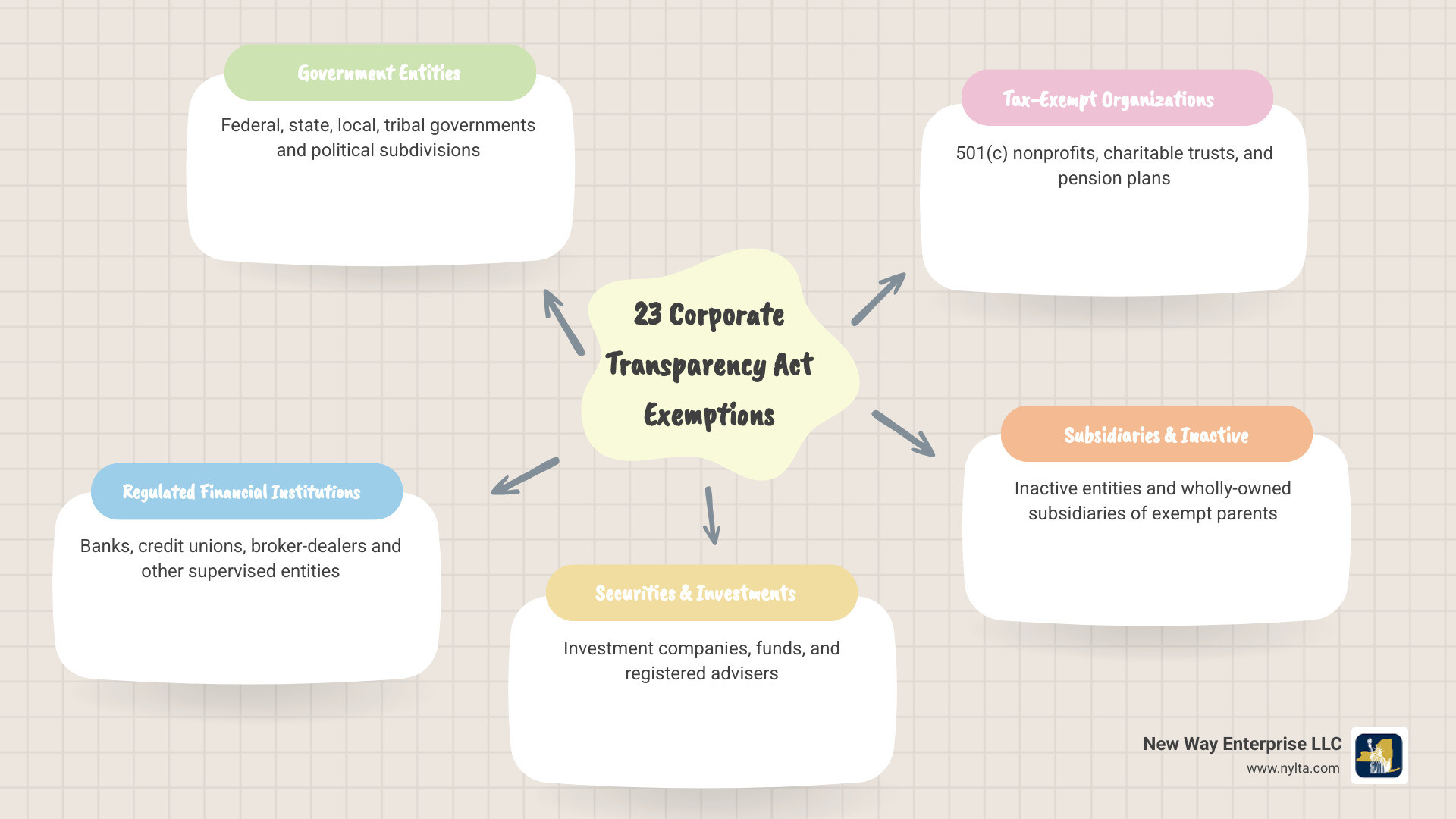
Quick Answer: The 23 CTA Exemptions at a Glance
Securities reporting issuers (publicly traded companies)
Government authorities (federal, state, local)
Banks
Credit unions
Depository institution holding companies
Money service businesses
Securities brokers or dealers
Securities exchanges or clearing agencies
Other SEC-registered entities
Investment companies or advisers
Venture capital fund advisers
Insurance companies
State-licensed insurance producers
Commodity Exchange Act entities
Public accounting firms
Public utilities
Financial market utilities
Pooled investment vehicles
Tax-exempt entities (501(c) organizations)
Entities assisting tax-exempt organizations
Inactive entities (dormant companies)
Large operating companies (20+ employees, $5M+ revenue)
Subsidiaries of certain exempt entities
If you're a foreign LLC owner operating in New York, understanding these exemptions is critical. The stakes are high—non-compliance can result in fines up to $10,000 and even criminal penalties including jail time. Companies that incorrectly claim exemptions face the same harsh consequences as those who simply fail to file.
The good news? Most exemptions target entities already subject to regulatory oversight—banks, insurance companies, and publicly traded firms. For private businesses, the three most relevant exemptions are large operating companies, tax-exempt entities, and inactive entities. Each has strict, specific criteria you must meet simultaneously.
This guide breaks down all 23 exemptions so you can determine your reporting obligations with confidence. Whether you're managing a single entity or a complex corporate structure, knowing where you stand can save you thousands in penalties and countless hours of compliance headaches.
Understanding the 23 Transparency Act Exemptions
Navigating the Corporate Transparency Act can feel like wandering through a legal maze, but the core logic is actually quite simple: FinCEN wants to know who owns companies that aren't already being watched by someone else. If your business is already "in the system" through the SEC, the IRS, or a state insurance board, you likely qualify for one of the transparency act exemptions.

The Small Entity Compliance Guide provided by FinCEN outlines these 23 categories in detail. Most of these exemptions are for highly regulated industries. For example, Securities reporting issuers (Exemption #1) are exempt because they already disclose their ownership to the SEC. Similarly, Government authorities (Exemption #2) and Public utilities (Exemption #16) are excluded because their structures are inherently transparent to the public.
Other specific exemptions include:
Financial market utilities: Entities designated by the Financial Stability Oversight Council.
Public accounting firms: Any firm registered in accordance with Section 102 of the Sarbanes-Oxley Act.
Tax-exempt entities: Organizations described in Section 501(c) of the Internal Revenue Code.
While the federal CTA is our primary focus, it is helpful to see how it compares to other transparency laws. For instance, the Land Owner Transparency Act (LOTA) in British Columbia has a different approach to exclusions.
Feature U.S. Corporate Transparency Act (CTA) B.C. Land Owner Transparency Act (LOTA) Total Exemptions 23 specific categories Varies by statutory definition Small Business Generally must report Excluded if not a "relevant corporation" Public Companies Exempt Excluded (Designated Stock Exchanges) Indigenous Land N/A Broad exclusions for Indigenous nations Inactive Status Specific 6-point test Not a primary exclusion category
The 'Big Three' Federal Reporting Exemptions
While there are 23 exemptions, most small-to-medium private businesses only need to worry about three. We call these the "Big Three" because they are the most likely paths for a non-regulated private company to avoid BOI reporting. These are Large Operating Companies, Tax-Exempt Entities, and Inactive Entities.
To qualify for these transparency act exemptions, an entity must meet all criteria for that specific category. You can't "mix and match" requirements from different exemptions.
Qualifying as a Large Operating Company
This is the "holy grail" of exemptions for successful private businesses. FinCEN assumes that if a company is large enough to have a significant workforce and revenue, it is less likely to be a shell company used for money laundering.
To qualify, your company must meet these three requirements simultaneously:
21 Full-Time Employees: You must employ more than 20 full-time employees in the United States. FinCEN defines "full-time" as averaging at least 30 hours of service per week or 130 hours per month. You cannot aggregate employees across multiple subsidiaries to reach this number. Each entity must stand on its own.
$5,000,000 in Revenue: Your company must have filed a federal income tax return in the U.S. for the previous year showing more than $5,000,000 in gross receipts or sales. This includes the receipts of other entities you control and file a consolidated return with.
Physical U.S. Address: You must have an operating presence at a physical office within the United States. A P.O. Box or the address of a third-party registered agent does not count.
According to the Final Rules on Reporting Requirements, if you drop below 21 employees or your revenue dips under $5 million, you have only 30 days to file a BOI report.
Criteria for Inactive Transparency Act Exemptions
Just because a company is "dead" doesn't mean it's exempt. To qualify as an inactive entity, you must meet a very strict six-part test:
The entity was in existence on or before January 1, 2020.
The entity is not engaged in active business.
The entity is not owned by a foreign person, whether directly or indirectly.
The entity has not experienced a change in ownership in the preceding 12 months.
The entity has not sent or received any funds greater than $1,000 in the preceding 12 months.
The entity does not hold any assets of any type (including ownership in other companies).
If you started an LLC in 2022 and just haven't used it yet, you do not qualify for this exemption because the entity was not in existence before 2020. You must still file a BOI report.
Tax-Exempt Entities and Transparency Act Exemptions
Most non-profits are exempt from the CTA, but the timing is everything. To be exempt, an organization must be:
An organization described in Section 501(c) of the Internal Revenue Code and exempt from tax under Section 501(a).
A political organization under Section 527(e)(1).
A charitable or split-interest trust.
The "Gray Period" Warning: If you have just formed a new non-profit and are waiting for your IRS determination letter, you are not yet exempt. You must file an initial BOI report with FinCEN. Once you receive your official 501(c) status from the IRS, you can then file an updated report to claim your exemption. If you lose your tax-exempt status, you have a 180-day grace period to either regain it or file a BOI report.
Regulated Entities and the Subsidiary Rule
A large portion of the transparency act exemptions list is dedicated to financial institutions. This is because these entities are already subject to heavy "Know Your Customer" (KYC) and Anti-Money Laundering (AML) regulations.
Exempt regulated entities include:
Banks and Credit Unions: Any bank as defined in the Federal Deposit Insurance Act or the Federal Reserve Act.
Money Service Businesses (MSBs): Money transmitters registered with FinCEN.
Securities Brokers and Dealers: Registered under Section 15 of the Securities Exchange Act.
Insurance Companies: As defined in Section 2 of the Investment Company Act of 1940.
The Subsidiary Exemption (Exemption #22) This is a powerful rule. If an entity's ownership interests are controlled or wholly owned by certain exempt entities, the subsidiary itself is also exempt. However, this doesn't apply to all 23 exemptions. For example, a subsidiary of a "Pooled Investment Vehicle" (Exemption #18) is not automatically exempt.
If you are a subsidiary of a bank or a large operating company, you likely don't need to file. But if the parent company only owns 90% of your business, you need to look closely at who owns the other 10% to ensure the "controlled or wholly owned" requirement is met.
International and State-Level Variations
While the CTA is a federal law, we are seeing similar movements elsewhere. In British Columbia, the Land Owner Transparency Act Exclusions provide a roadmap for who doesn't have to file with their Land Owner Transparency Registry (LOTR). Exclusions there include strata corporations (similar to HOAs) and corporations wholly owned by Indigenous nations.
In the United States, New York has introduced the New York LLC Transparency Act (NYLTA). While it mirrors much of the federal CTA, it has its own specific filing requirements and deadlines. For businesses operating in the Empire State, transparency act exemptions under the federal law often carry over, but you must still file an "Exemption Affirmation" with the New York Department of State (NYDOS).
Compliance Timelines and Penalties for Misclassification
The clock is ticking. If your company was formed before January 1, 2024, and you don't qualify for one of the transparency act exemptions, your deadline to file is January 1, 2025.
For new companies formed in 2024, you have 90 days from the date of formation to file. For companies formed in 2025 and beyond, that window shrinks to just 30 days.
The Cost of Getting it Wrong Mistakenly claiming an exemption is not a "whoopsie." FinCEN can impose:
Civil Penalties: Up to $500 for each day the violation continues (adjusted for inflation, this is now over $590).
Criminal Penalties: Fines up to $10,000 and up to two years in prison.
We recommend keeping a "Compliance Folder" that contains the evidence you used to claim an exemption—such as your prior year's tax returns for the large operating company exemption or your IRS determination letter for the tax-exempt status.
Frequently Asked Questions about Transparency Act Exemptions
What happens if my company loses its exempt status?
If your company no longer meets the criteria for an exemption (for example, you lay off employees and now have fewer than 21, or your revenue drops below $5 million), you must file a BOI report within 30 calendar days. This 30-day rule also applies if you sell a dormant company to a new owner—the "inactive" exemption is immediately lost.
Do foreign-owned subsidiaries qualify for exemptions?
It depends. A U.S. subsidiary that is 100% owned by a foreign parent company does not automatically qualify for the subsidiary exemption because the parent company itself is not one of the 23 exempt types (unless the parent is a foreign bank or similar regulated entity). However, if that U.S. subsidiary independently qualifies as a "Large Operating Company" (21+ employees and $5M+ U.S. revenue), it can claim that exemption.
How do I document my exemption claim for FinCEN?
You do not actually "file" for an exemption with FinCEN in the way you file for a tax refund. Instead, you simply don't file a BOI report. However, you must be prepared to prove your status if audited. We suggest maintaining:
Payroll records showing 21+ full-time U.S. employees.
Signed federal tax returns showing $5M+ in gross receipts.
A copy of your lease or deed for a physical U.S. office.
Conclusion
The Corporate Transparency Act is a massive shift in how we handle business privacy in the U.S. While the 23 transparency act exemptions offer a reprieve for many, they require careful, ongoing monitoring. A company that is exempt today might be a reporting company tomorrow.
At New Way Enterprise LLC, we understand that keeping up with these changes is a full-time job. If you are navigating the complexities of New York's specific requirements, NYLTA.com is here to help. As New York’s first dedicated platform for automated status assessment and secure filings, we take the guesswork out of compliance. Whether you need a compliance review, ongoing monitoring, or help tracking the latest NYDOS guidance, we ensure your business stays on the right side of the law without the stress.
Don't wait for a $10,000 fine to find out if you were supposed to file. Take the time today to verify your status and secure your company's future.