
Everything You Need to Know About LLC Ownership Disclosure
What the LLC BOI Exemption Means for Your Business in 2026
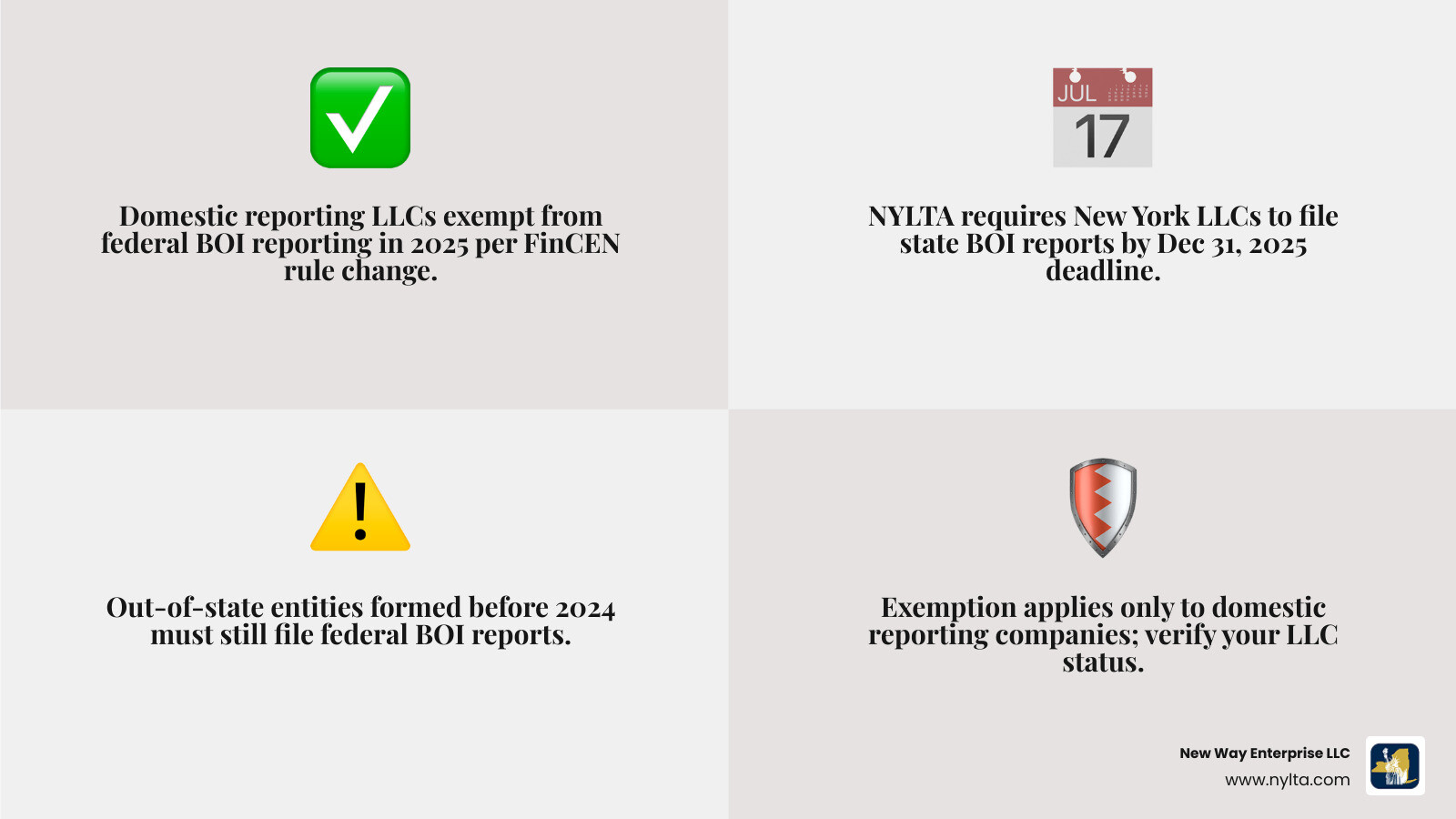
The LLC BOI exemption is a established reality for millions of U.S. business owners. Since the March 2025 ruling, FinCEN's interim final rule has fully exempted all U.S.-formed LLCs from federal Beneficial Ownership Information (BOI) reporting requirements under the Corporate Transparency Act (CTA).
Here is what you need to know right now:
U.S.-formed LLCs: Fully exempt - no BOI report required
Previously filed BOI reports (for domestic entities): No updates or corrections needed
Foreign LLCs registered in the U.S.: Still required to file - deadlines apply
New York LLCs: The federal exemption does not cover the New York LLC Transparency Act (NYLTA), which is now in effect as of January 1, 2026
This was a major shift in the regulatory landscape. Before this rule, roughly 32 million businesses were expected to file BOI reports with FinCEN. While that federal compliance burden has been lifted for most, it remains in place for foreign entities and those operating in New York state.
I'm Ryan De Freitas, Founder and CEO of New Way Enterprise LLC and the compliance platform behind NYLTA.com (a private platform not affiliated with any government agencies), where I specialize in building systems that simplify exactly this kind of regulatory complexity - including the intersection of the federal LLC BOI exemption and New York's separate state-level transparency requirements. Let's break down what changed, who it affects, and what action you still need to take.
The FinCEN Rule Change and the LLC BOI Exemption
The landscape of American business compliance changed significantly with an announcement on March 21, 2025. The Financial Crimes Enforcement Network (FinCEN), a bureau of the U.S. Department of the Treasury, issued an Interim Final Rule that effectively dismantled the reporting burden for the vast majority of small businesses in the United States.
Under this rule, the definition of a "reporting company" was fundamentally narrowed. Previously, the Corporate Transparency Act (CTA) cast a wide net, catching almost every small LLC, corporation, and limited partnership formed within the U.S. Now, those entities-referred to as domestic reporting companies-are 100% exempt.
This LLC BOI exemption means that if your company was created by filing a document with a secretary of state or a similar office in any U.S. state or Indian Tribe, you are no longer required to tell the federal government who owns or controls your business. This relief extends to "U.S. persons" (citizens and permanent residents) who previously had to disclose their sensitive personal information. You can find more details on the specific llc-exemption-requirements on our dedicated guide.
Understanding the Scope of the LLC BOI Exemption
It is important to understand just how broad this "domestic" exemption is. If your LLC was formed in Delaware, Wyoming, New York, or any other U.S. state, you fall under this umbrella. FinCEN has essentially hit the "reset" button for U.S.-formed entities.
This is retroactive relief. Even if your business was formed years ago or just recently, as long as it is a U.S. entity, the federal reporting requirement is gone. Beneficial owners who are U.S. citizens or permanent residents no longer need to worry about their names, home addresses, or driver's license images sitting in a federal database for these domestic companies. For the most current official stance, we always recommend you check out the BOI webpage at FinCEN.gov.
Impact on Previously Filed BOI Reports
We have heard from many of you who were proactive and filed your BOI reports early in 2024 or 2025. You might be wondering, "Do I need to go back in and withdraw my report?"
The short answer is: No. As of the March 26, 2025, effective date, domestic filers do not need to take any further action. You don't need to file "corrected" reports or "updates" to tell FinCEN you are now exempt. While your information may still exist within the FinCEN database from your previous filing, the legal obligation to keep that information updated has been removed for U.S. companies. If you are curious about what that beneficial-owner-report-form used to look like or why it was required, we have archived that information for historical reference.
Who Still Needs to File Federal BOI Reports?
While the LLC BOI exemption is a massive win for domestic businesses, the Corporate Transparency Act hasn't been completely repealed. It has simply been refocused. The primary group that still must comply consists of foreign reporting companies.
A foreign reporting company is an entity (like an LLC or corporation) formed under the laws of a foreign country that has registered to do business in any U.S. state or tribal jurisdiction. If you have a "Foreign LLC" that you registered with a Secretary of State to operate within the U.S., you are likely still on the hook.
There are two critical windows to keep in mind for these entities:
Registered before March 26, 2025: The deadline to file your form to report BOI was April 25, 2025. If you have not filed, you may be subject to penalties.
Registered on or after March 26, 2025: You have a 30-day window from the time you receive notice that your registration is effective to file your initial report.
Missing these dates can be costly, so it is vital to track your specific BOI reporting deadline carefully.
Criteria for Remaining LLC BOI Exemption Categories
Even for foreign entities, there are still "carve-outs" or exemptions. The original CTA listed 23 categories of exempt entities. These were mostly highly regulated businesses that already report ownership information to other government agencies.
Feature Federal FinCEN (CTA) New York (NYLTA) Domestic LLCs 100% Exempt (as of March 2025) Required to File (unless exempt) Foreign LLCs Required to File Required to File Effective Date Ongoing (Revised March 2025) January 1, 2026 Exemptions 23 Categories (Large Ops, Banks, etc.) Follows Federal Categories Who to Report 25% owners / Substantial Control 25% owners / Substantial Control
One of the most common exemptions is the Large Operating Company exemption. To qualify, a company must meet all three of these criteria:
Employ more than 20 full-time employees in the U.S.
Have more than $5 million in gross receipts or sales (reported on Form 1120 or similar IRS forms like 1120-S or 1065).
Operate from a physical office located within the U.S.
Other exempt groups include entities registered with the Securities and Exchange Commission, banks, credit unions, and certain tax-exempt nonprofits.
Beneficial Ownership for Foreign Reporting Companies
For the foreign companies that do still need to report, the definition of a "beneficial owner" remains the same. A beneficial owner is any individual who, directly or indirectly:
Exercises substantial control over the company (like a CEO, CFO, or a "senior officer").
Owns or controls at least 25% of the ownership interests.
Identifying these individuals can be tricky, especially when ownership is held through trusts or other complex layers. We've put together a guide on Who Counts as a Beneficial Owner Under NYLTA? Common Mistakes to Avoid When Filing which uses the same ownership logic applied at the federal level.
To make future filings easier, individuals can apply for a FinCEN identifier, which allows them to provide their personal data to FinCEN once and use a unique ID number on future reports instead of resubmitting their private documents every time.
Federal vs. State: The New York LLC Transparency Act (NYLTA)
Now, here is the part where we need to pay very close attention. A lot of business owners hear "Federal Exemption" and think they are completely off the hook. If you have an LLC formed in New York or registered to do business in the Empire State, that is not the case.
New York has implemented its own version of the law: the New York LLC Transparency Act (NYLTA). While the federal government decided to step back from domestic reporting, New York has moved forward.
It is critical to understand that NYLTA and FinCEN CTA filings are separate and one does not satisfy the other. Filing a federal report (if you were required to) does not satisfy New York's requirements, and the federal LLC BOI exemption does not apply to New York state law.
Key facts about NYLTA:
Effective Date: January 1, 2026 (Now in effect).
Scope: Applies to all LLCs formed in NY or foreign LLCs authorized to do business in NY.
The "Think Again" Moment: Many owners assume that because they are a "small" or "inactive" business, they don't have to file. We strongly suggest you read Think You Are Exempt from NYLTA? Think Again - New York to see how the state rules differ.
Exemptions: NYLTA generally adopts the same 23 categories as the federal CTA, but you must still file an Exemption Affirmation with the New York Department of State (NYDOS) to claim them.
At NYLTA.com, we are tracking NYDOS guidance daily to ensure our users are compliant with the beneficial-ownership-filing requirements now that the law is active.
Avoiding Scams and Ensuring Compliance
Whenever there is a major regulatory change, scammers come out of the woodwork. Since the LLC BOI exemption news broke, we have seen an uptick in fraudulent correspondence.
Scammers often send official-looking emails or letters (sometimes even with QR codes) urging you to "Register Now" or "Pay Your BOI Fee" to avoid fines. Some even reference fake forms like "Form 4022" or "Form 5102."
Here is the truth: FinCEN does not charge a fee to file. If someone is asking you for money to "submit" your report to the government, they are likely a scammer. Always verify that you are on a ".gov" website before entering any information.
The Federal Crimes Enforcement Network will never send you a random email asking for personal data. If you are ever in doubt, refer to the official Small Entity Compliance Guide provided by the government, or use a trusted, private compliance partner like NYLTA.com to review your status.
Frequently Asked Questions about LLC BOI Reporting
Do I need to file if I already submitted a report for a U.S. LLC?
No. Following the 2025 rule change, domestic entities are exempt. You do not need to take any further action to "cancel" or "update" your previous filing. U.S. persons associated with domestic LLCs are no longer required to report.
What are the penalties for non-compliance for foreign entities?
For foreign entities that are still required to report, the penalties remain severe. Civil penalties can reach up to $591 per day (adjusted for inflation). Willful violations can lead to criminal fines of up to $10,000 and even imprisonment for up to two years. Compliance is not optional for those who still fall under the "reporting company" definition.
Does the federal LLC BOI exemption apply to New York state filings?
Absolutely not. The NYLTA is a state-level law that went into effect on January 1, 2026. Even if you are exempt federally, you must still comply with New York's disclosure or exemption affirmation requirements. This is a common point of confusion that could lead to state-level penalties if ignored.
Conclusion
The world of LLC ownership disclosure has evolved rapidly. While the federal LLC BOI exemption has provided immense relief to millions of domestic small business owners, the "transparency" trend is far from over-it has simply shifted to the state level.
At New Way Enterprise LLC, we built NYLTA.com specifically to handle this "New York problem." We provide an automated status assessment to help you determine if you are actually exempt or if you need to file under the state's rules. Our platform offers secure beneficial-ownership-filing and ongoing monitoring so you never have to worry about missing a deadline or a change in NYDOS guidance.
Don't let the federal news lull you into a false sense of security if you have ties to New York. The January 1, 2026, deadline has passed, and compliance is now mandatory for all covered entities.
Ready to clear the confusion? Visit NYLTA.com today to run a free compliance check and ensure your New York LLC stays on the right side of the law. Please note that NYLTA.com is a private platform and is not affiliated with any government agencies. We'll handle the monitoring; you handle the business.